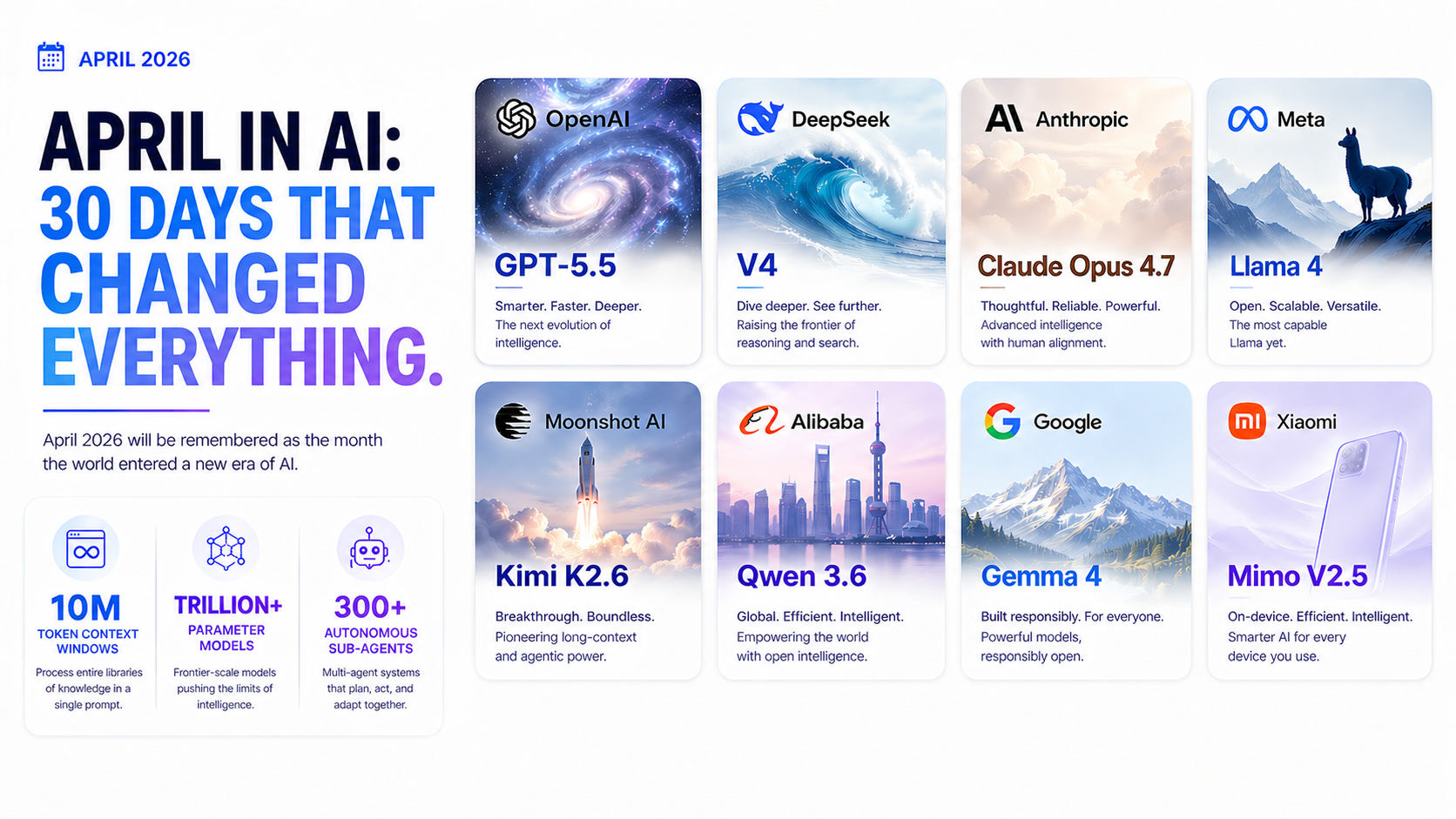
In a single month, nearly every major AI lab shipped a flagship model. Context windows ballooned to millions of tokens. Autonomous agents became real. And consumer-tech giants entered the arena. This is what just happened.
If it feels like AI progress is accelerating, that's because it genuinely is. Over the past thirty days, the industry witnessed an extraordinary wave of model releases, architecture upgrades, and capability breakthroughs from nearly every major player — OpenAI, Google, Meta, Alibaba, Anthropic, DeepSeek, Moonshot AI, and beyond. What follows is a record of what just happened, and why it matters.
Early April
The Model Explosion
April opened with a burst of releases that set the tone for the weeks ahead. Open-source models demonstrated they could punch well above their weight, long-context AI took a dramatic leap forward, and challengers to incumbent leaders made credible claims on benchmark leaderboards.
- Google
Gemma 4 31B
Open-source and surprisingly capable — early evaluations showed it outperforming models several times its size, raising serious questions about efficiency-versus-scale tradeoffs.
- Zhipu AI
GLM-5.1
Claimed to surpass GPT-4-class models on coding benchmarks — a notable assertion from a lab that has quietly become one of the most competitive in China's AI ecosystem.
- Meta
Llama 4
A 10 million token context window. Not a typo. Llama 4 pushed the frontier of long-context reasoning to a scale that makes most prior work look incremental.
Mid-April
Competition Heats Up
The middle weeks brought some of the most technically ambitious releases of the month. Anthropic pushed its flagship reasoning model forward. Alibaba dominated open-source coding benchmarks across multiple simultaneous releases. And one Chinese lab unveiled something that stopped the industry in its tracks: a trillion-parameter mixture-of-experts model running over 300 parallel sub-agents for more than twelve hours at a stretch.
- Anthropic
Claude Opus 4.7
A meaningful leap in reasoning depth and long-horizon agent workflows, reinforcing Anthropic's position at the frontier of reliable, capable AI systems.
- Alibaba
Qwen 3.6 Series
Multiple simultaneous releases — open-source and proprietary — across different scales. The series dominated coding and reasoning leaderboards and signaled China's growing model output velocity.
- Moonshot AI
Kimi K2.6
A 1-trillion-parameter MoE model orchestrating 300 sub-agents running autonomously for 12+ hours. The clearest signal yet that agentic AI has moved from research curiosity to operational reality.
As side of note...
"Kimi K2.6 wasn't just a language model release — it was a demonstration that persistent, multi-agent AI systems can operate at a scale and duration that starts to resemble software infrastructure."
Late April
The Heavy Hitters Arrive
Then came the releases that commanded the most attention. OpenAI continued its push into autonomous workflows. And DeepSeek — the lab that shocked the industry earlier this year — returned with a model that again upended assumptions about what cutting-edge AI is supposed to cost.
- OpenAI
GPT-5.5
Smarter, more agentic, and significantly stronger at code generation. GPT-5.5 continues OpenAI's deliberate shift from conversational assistant to autonomous workflow engine.
- DeepSeek
DeepSeek V4 Pro/Flash
Open weights. 1.6 trillion parameters. 1 million token context. Reportedly achieves GPT-class performance at a fraction of the compute cost — continuing DeepSeek's pattern of disrupting cost assumptions at the frontier.
Yesterday
And Just Yesterday…
One more entrant, easy to overlook amid the noise — but worth noting for what it signals about where this industry is heading.
- Xiaomi
MiMo V2.5
Quietly released by one of the world's largest consumer hardware companies. It's not the most powerful model of the month — but it may be the most telling. Consumer-tech giants are now fully in the AI model race.
What It Means
Three Shifts Underway
This isn't simply "more models." The past thirty days reflect three structural changes in how the AI industry operates — changes that will compound over the months ahead.
1. The Cost Floor Is Collapsing
DeepSeek V4 is the starkest example: frontier-level capability at a fraction of historically expected compute cost. This threatens the moats of every incumbent built on infrastructure advantage and forces a rethinking of AI business models industry-wide.
2. Agents Are Becoming Real Infrastructure
Kimi K2.6 and GPT-5.5 both point in the same direction: AI is no longer primarily a question-and-answer interface. The transition from chatbot to persistent autonomous system is underway — and it will reshape what "deploying AI" means for enterprises.
3. The Competitor Set Has Expanded
From deep-learning labs to smartphone manufacturers, the barrier to entering the frontier model race is falling. Xiaomi's release is early evidence of a coming wave: hardware companies, cloud providers, and platform businesses all fielding capable models of their own.
10M+
Token context window
reached by Llama 4
reached by Llama 4
1.6T
Parameters in
DeepSeek V4
DeepSeek V4
300
Sub-agents running
in Kimi K2.6
in Kimi K2.6
8+
Labs shipping
major models
major models
The Bigger Picture
We're Not Done Yet
April isn't over. With a week still remaining, additional flagship models, open-weight releases, and agent breakthroughs remain possible before the month closes. And if the past three weeks are any guide, the pace will not slow.
Context windows jumped to scales previously considered unnecessary. Open-source models caught up to proprietary ones on several key benchmarks. And new entrants arrived from outside traditional AI research circles. Each of these individually would have been notable. Together, in a single month, they represent something more fundamental: a compression of the AI development timeline that few predicted would happen this quickly.
Final Thought
The AI race is no longer yearly. It stopped being monthly some time ago. It is weekly now — and April 2026 may be the clearest evidence yet that we are just getting started.